


Most trees take between 10 and 30 years to reach full maturity, but the honest answer depends entirely on the species and where you plant it. A hybrid poplar can shoot up eight feet in a single year and give you shade within five. A white oak planted in the same yard might still be a sapling when your kids leave for college. After more than a decade of caring for trees across Portland, the Mossy Tree Care team has watched this play out in hundreds of yards, and the pattern is always the same: people underestimate how fast some trees grow and overestimate how fast others do. This guide breaks down growth rates for 30 common species, explains what actually controls the speed, and gives you realistic timelines so you know what to expect before you plant.
The Five Stages of Tree Growth
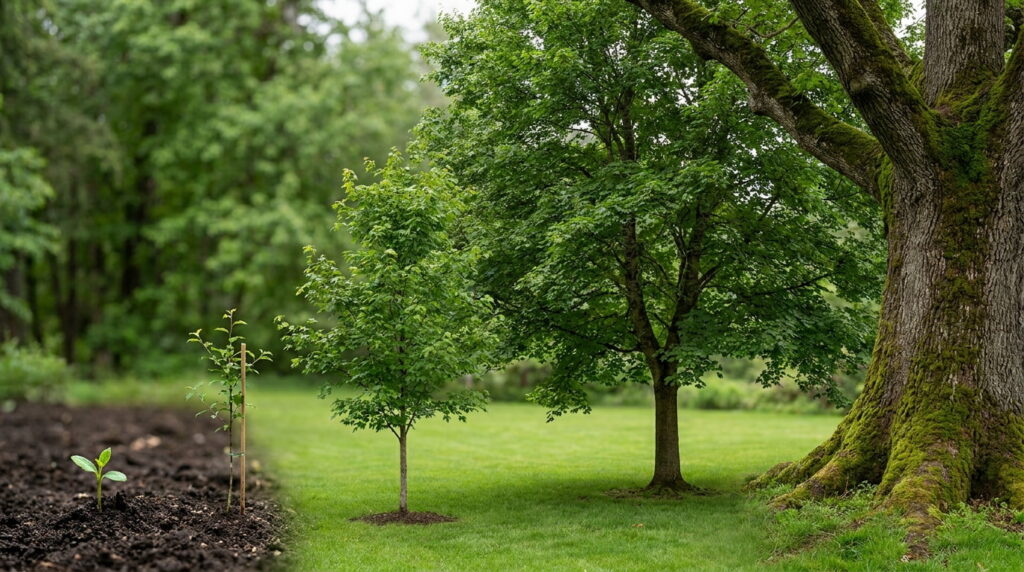
Every tree, whether it ends up fifteen feet tall or two hundred, goes through the same basic stages.
Seed germination is the starting line. A seed absorbs water, cracks open, and sends out a root and a shoot. Most tree seeds germinate in one to three weeks under the right conditions, though some species like oaks need a cold period called stratification before they will sprout at all.
Seedling stage covers the first one to three years. The tree is small, fragile, and focused on building a root system. Above ground it might only be a few inches to a couple of feet tall. Below ground the roots are already spreading wider than most people realize.
Sapling stage runs from roughly year three to year ten, depending on species. The trunk thickens, the canopy starts to fill in, and growth accelerates. This is when the difference between fast growers and slow growers becomes obvious. A sapling is generally defined as a young tree with a trunk diameter between one and four inches at chest height.
Mature tree is the stage most people are really asking about. A mature tree has reached its full height or close to it, produces seeds or fruit, and provides meaningful shade. For fast growers, maturity can arrive in as little as 10 to 15 years. For slow growers, 50 to 100 years is normal.
Ancient tree status belongs to specimens that have been growing for centuries. Bristlecone pines in the White Mountains of California have been dated at over 4,800 years old. Western red cedars in the Pacific Northwest regularly exceed 1,000 years. These are the exceptions, but they show what trees are capable of when they are left alone in the right conditions.
Tree Growth Rate Categories
The Arbor Day Foundation classifies tree growth into three broad categories based on how much height a tree adds per year once established.
Fast growing trees add two or more feet of height per year. These are the trees you plant when you want results quickly. Hybrid poplars, willows, and certain maples fall into this group. The tradeoff, as any arborist will tell you, is that fast growers tend to have weaker wood and shorter lifespans. A hybrid poplar that grows eight feet a year might only live 20 to 30 years, while a slow growing oak can stand for centuries.
Moderate growing trees add one to two feet per year. This is where most popular landscape trees land. Red maples, birches, and many fruit trees grow at this pace. You will wait longer for shade, but the wood is stronger and the tree will be around for your grandchildren.
Slow growing trees add less than one foot per year. Oaks, hemlocks, and many evergreens fall here. These trees test your patience, but they reward it with longevity, structural strength, and deep root systems that make them far more resistant to storms.
Growth Rates for 30 Common Tree Species
The table below ranks 30 popular species by their annual growth rate. Heights and timelines are based on data from the Arbor Day Foundation, Oregon State University Extension, and the USDA Forest Service urban tree database.
Fast Growing Trees (2+ feet per year)
| Species | Annual Growth | Mature Height | Years to Shade | Lifespan |
|---|---|---|---|---|
| Hybrid Poplar | 5 to 8 ft | 40 to 50 ft | 3 to 5 years | 20 to 30 years |
| Weeping Willow | 3 to 8 ft | 30 to 40 ft | 4 to 6 years | 30 to 50 years |
| Dawn Redwood | 3 to 4 ft | 70 to 100 ft | 6 to 8 years | 100+ years |
| Quaking Aspen | 2 to 3 ft | 40 to 50 ft | 5 to 8 years | 50 to 80 years |
| Red Alder | 2 to 3 ft | 40 to 60 ft | 5 to 8 years | 80 to 100 years |
| Douglas Fir | 2 to 3 ft | 200 to 250 ft | 8 to 12 years | 500+ years |
| Leyland Cypress | 2 to 3 ft | 60 to 70 ft | 5 to 7 years | 20 to 25 years |
| Green Giant Arborvitae | 2 to 3 ft | 50 to 60 ft | 5 to 7 years | 40+ years |
| Pin Oak | 2 to 3 ft | 60 to 70 ft | 8 to 10 years | 100+ years |
| Lombardy Poplar | 3 to 6 ft | 40 to 60 ft | 3 to 5 years | 15 to 25 years |
| Tulip Poplar | 2 to 3 ft | 70 to 90 ft | 6 to 8 years | 200+ years |
| Silver Maple | 2 to 3 ft | 50 to 70 ft | 5 to 8 years | 100+ years |
| River Birch | 1.5 to 2 ft | 40 to 70 ft | 6 to 8 years | 50 to 75 years |
Moderate Growing Trees (1 to 2 feet per year)
| Species | Annual Growth | Mature Height | Years to Shade | Lifespan |
|---|---|---|---|---|
| Red Maple | 1 to 2 ft | 40 to 60 ft | 8 to 12 years | 100 to 200 years |
| Bigleaf Maple | 1.5 to 2 ft | 50 to 100 ft | 8 to 12 years | 200+ years |
| Western Red Cedar | 1.5 to 2 ft | 150 to 200 ft | 10 to 15 years | 1,000+ years |
| Paper Birch | 1.5 to 2 ft | 50 to 70 ft | 8 to 10 years | 60 to 80 years |
| American Sycamore | 1 to 2 ft | 75 to 100 ft | 10 to 12 years | 200+ years |
| Sugar Maple | 1 to 2 ft | 60 to 75 ft | 10 to 15 years | 300+ years |
| Oregon Ash | 1 to 2 ft | 40 to 80 ft | 10 to 12 years | 200 to 250 years |
| Northern Red Oak | 1 to 2 ft | 60 to 75 ft | 12 to 15 years | 200+ years |
| Colorado Blue Spruce | 1 to 1.5 ft | 50 to 75 ft | 12 to 15 years | 200+ years |
Slow Growing Trees (less than 1 foot per year)
| Species | Annual Growth | Mature Height | Years to Shade | Lifespan |
|---|---|---|---|---|
| White Oak | 1 ft or less | 60 to 80 ft | 15 to 20 years | 300 to 600 years |
| Eastern Hemlock | 1 ft or less | 40 to 70 ft | 15 to 20 years | 800+ years |
| Live Oak | 1 ft or less | 40 to 80 ft | 15 to 20 years | 500+ years |
| Japanese Maple | 6 to 12 in | 15 to 25 ft | 10 to 15 years | 100+ years |
| Bur Oak | 1 ft or less | 60 to 80 ft | 20+ years | 300 to 400 years |
| Southern Magnolia | 1 ft or less | 60 to 80 ft | 12 to 15 years | 100+ years |
| American Holly | 6 to 12 in | 30 to 50 ft | 15 to 20 years | 100+ years |
| Bristlecone Pine | Under 6 in | 15 to 30 ft | 30+ years | 4,800+ years |
Notice the pattern: the fastest growing trees are almost always the shortest lived. A hybrid poplar gives you shade in three years but might be dead in twenty. A white oak takes fifteen years to provide real shade but could outlive the house it is shading by three centuries. This inverse relationship between growth speed and lifespan is one of the most important things to understand when choosing what to plant, and it is something that most online guides skip over entirely.
Trees That Grow Best in the Pacific Northwest
Portland sits in USDA Hardiness Zone 8b, which means mild, wet winters and warm, dry summers. This climate is exceptionally good for growing trees. Several native species thrive here that you will not find in most national tree growth guides, and as a Portland tree care company we see these species in yards across the metro area every week.
Douglas fir is Oregon’s most iconic tree and one of the tallest species in the world. Young Douglas firs grow two to three feet per year in western Oregon’s climate, and mature specimens regularly exceed 200 feet. The Oregon State University Extension Service notes that Douglas firs can live well over 500 years in the wild. In a residential yard, expect a Douglas fir to reach 40 to 60 feet within 20 years with proper care.
Western red cedar grows one and a half to two feet per year and can eventually reach 150 to 200 feet in forested settings. In a yard, 40 to 60 feet is more typical. These trees are remarkably long lived. Specimens in the coastal forests of Oregon and Washington have been dated at over 1,000 years old. Western red cedar is naturally resistant to rot and insects, which makes it one of the lowest maintenance large trees you can plant.
Red alder is the fastest growing native hardwood in the Pacific Northwest, adding up to three feet of height per year. It is also a nitrogen fixer, meaning it actually improves the soil around it as it grows. Red alder is commonly found along streams and in disturbed areas throughout the Willamette Valley.
Bigleaf maple is the largest maple species in North America, with leaves that can span twelve inches across. It grows one and a half to two feet per year and provides excellent shade once it reaches 30 to 40 feet, which typically takes 15 to 20 years in a Portland yard. Bigleaf maples are native throughout western Oregon and are a common sight in Forest Park and along neighborhood streets.
Oregon ash is the only native ash species in the state. It grows one to two feet per year and thrives in the wet, heavy soils that are common in the Portland metro area. Oregon ash is deciduous and turns a bright gold in fall before dropping its leaves.
If you are planting in the Portland area and want a tree that will grow reliably without fighting the local climate, starting with a species native to the Willamette Valley is always a smart move.
How Long Until a Tree Gives You Shade?
This is the question behind most searches on this topic. People are not planting trees to admire twigs. They want shade for their yard, their patio, or their south facing windows.
The answer depends on three things: the species growth rate, the canopy spread at maturity, and the size of the tree at planting.
Most shade trees need a canopy spread of at least 20 feet before they provide meaningful coverage over a patio or yard. Fast growing species like silver maple or tulip poplar can reach this spread in 8 to 10 years from a nursery sapling. Slow growers like white oak might take 15 to 20 years.
You can buy time by starting with a larger tree. A two inch caliper tree from a nursery is typically 10 to 12 feet tall and already has several years of growth behind it. Compared to planting a one gallon seedling, you might skip three to five years of waiting. The cost difference is significant though. A one gallon seedling might run $15 to $30, while a two inch caliper balled and burlapped tree can cost $200 to $500 or more, plus delivery and planting.
For Portland specifically, the fastest path to shade with a native tree is red alder (shade in 5 to 8 years) or bigleaf maple (shade in 10 to 15 years). If you are willing to plant a non native, a dawn redwood or tulip poplar will get you there in 6 to 8 years.
How Long Does It Take to Grow a Fruit Tree?
Fruit trees follow their own timeline that is less about total height and more about when they start producing. Here is what to expect from common fruit trees planted in the Pacific Northwest.
Apple trees typically take 4 to 8 years to produce their first fruit from a nursery sapling, depending on whether you plant a standard, semi dwarf, or dwarf variety. Dwarf varieties on rootstock like M9 can fruit in as little as 2 to 3 years.
Cherry trees produce fruit in 4 to 7 years. Sweet cherries take longer than sour cherries. The Willamette Valley is one of the best cherry growing regions in the country.
Pear trees take 4 to 6 years for first fruit. European pears and Asian pears have similar timelines but different harvest windows.
Peach trees are among the faster producers at 2 to 4 years to first fruit, though they require more heat than Portland typically provides and do best in the warmer microclimates east of the Cascades.
Fig trees can produce fruit in 1 to 2 years from a nursery plant. Figs thrive in Portland’s climate and are an increasingly popular backyard tree in the metro area.
Plum trees take 3 to 6 years. Italian prune plums are an Oregon staple and do exceptionally well in the Willamette Valley.
If you are planting fruit trees, keep in mind that some species need a second tree nearby for cross pollination. Apples, pears, and sweet cherries generally need a compatible pollinator variety within 50 to 100 feet to set fruit reliably.
What Affects How Fast a Tree Grows?
Species genetics set the ceiling, but five environmental factors determine whether a tree actually reaches its potential growth rate.
Sunlight is the primary energy source. Most trees need six to eight hours of direct sun per day for optimal growth. Shade tolerant species like hemlock and Western red cedar can manage with less, but even they grow faster in full sun. A tree planted on the north side of a building in deep shade will grow significantly slower than the same species planted in an open yard.
Water is critical in the first three to five years. Newly planted trees need consistent moisture while their root systems establish. The general guideline is ten gallons of water per week for every inch of trunk diameter. Portland’s dry summers mean supplemental watering from July through September is essential, even for native species.
Soil quality makes a bigger difference than most people expect. Compacted urban soil, which is common in newer Portland subdivisions where construction equipment compressed the ground, can slow root growth by 50% or more compared to loose, well drained soil. Research from the USDA Forest Service has documented that urban trees often grow at significantly different rates than the same species in forest settings, largely because of soil compaction and reduced root space.
Climate and hardiness zone determine which species will thrive and which will struggle. A tree planted outside its recommended USDA zone may survive but will almost certainly grow slower and live shorter than the same species in its ideal range.
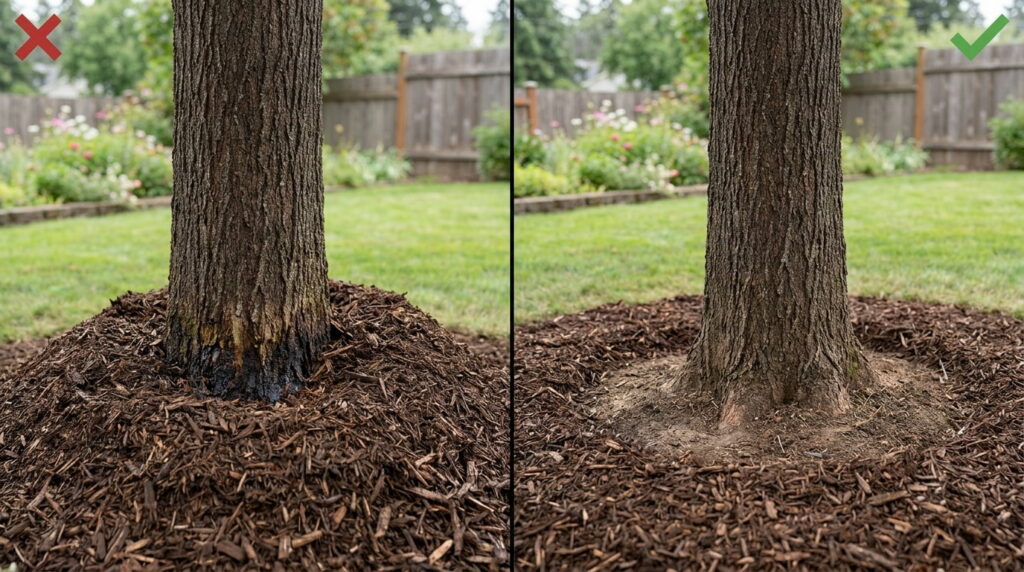
Maintenance and care can meaningfully accelerate growth. Proper mulching (a three to four inch ring of organic mulch kept six inches from the trunk) conserves moisture, regulates soil temperature, and adds nutrients as it breaks down. Structural pruning in the first ten years directs the tree’s energy into a strong central leader rather than competing branches. Deep root fertilization delivers nutrients directly to the root zone where the tree can actually use them.
How to Make a Tree Grow Faster
There is no trick that overrides genetics. A white oak is never going to grow eight feet in a year no matter what you do. But you can make sure a tree hits its maximum potential growth rate by removing the obstacles that slow it down.
Plant it right. Dig the hole two to three times wider than the root ball but no deeper. The root flare (where the trunk widens at the base) should sit at or slightly above ground level. Planting too deep is one of the most common mistakes and it can stunt growth for years.
Water deeply, not frequently. Deep watering encourages roots to grow down into the soil where moisture is more stable. Shallow daily watering keeps roots near the surface where they dry out quickly and are more vulnerable to heat.
Mulch the base. Organic mulch retains moisture, suppresses weeds that compete for nutrients, and feeds the soil as it decomposes. According to the University of Maryland Extension, a proper mulch ring significantly reduces water loss during dry summer months and protects the root zone from temperature extremes.
Avoid over fertilizing. More fertilizer does not mean faster growth. Excess nitrogen pushes rapid, weak top growth at the expense of root development. If you fertilize at all, a slow release formula applied in early spring is usually sufficient.
Get professional pruning early. The first five to ten years of a tree’s life set its structural framework for decades. Corrective pruning during the sapling stage is far easier and more effective than trying to fix a poorly shaped mature tree. If you are in the Portland area, Mossy Tree Care can help with young tree training pruning to set your trees up for strong, healthy growth.
Common Tree Growth Mistakes
Planting too deep buries the root flare, suffocates surface roots, and can lead to girdling roots that slowly strangle the tree over the course of years. The number one cause of slow growth in recently planted trees.
Volcano mulching means piling mulch against the trunk in a mound. This traps moisture against the bark, promotes rot and fungal disease, and attracts boring insects. Keep mulch six inches away from the trunk.
Staking too long weakens the trunk. Trees develop strength by flexing in the wind. Staking should be removed after the first growing season unless the site is exceptionally windy.
Ignoring soil compaction is especially common in new construction neighborhoods. If the builder graded the lot with heavy equipment, the soil in your yard may be compressed to the point where roots cannot penetrate. Aeration or soil amendment before planting can make a dramatic difference.
Choosing the wrong species for your climate leads to a tree that survives but never thrives. A tree at the edge of its hardiness zone will grow slower, stress more easily, and be more susceptible to disease. This is why local knowledge matters. A tree that performs well in Atlanta may struggle in Portland, or vice versa.
Do Trees Grow in Winter?
Above ground, most deciduous trees go dormant in winter and stop adding height. But below ground, roots continue growing as long as the soil temperature stays above about 40 degrees Fahrenheit. In Portland, where winters are mild and soil rarely freezes, root growth continues through much of the winter. This is actually one of the reasons fall and early winter planting works so well in the Pacific Northwest. The tree can establish roots for months before it needs to push out leaves in spring.
Evergreen conifers like Douglas fir and Western red cedar continue some above ground growth through mild winters as well, though at a much slower rate than during the active growing season from April through September.
Frequently Asked Questions
How long does it take for a tree to fully grow?
Most trees reach full maturity in 20 to 30 years, but the range is enormous. Fast growing species like hybrid poplar can reach their full size in 10 to 15 years. Slow growing species like white oak may take 50 to 100 years to reach full maturity. The species you choose is the single biggest factor in how long you will wait.
What is the fastest growing tree?
The hybrid poplar is the fastest growing tree commonly planted in North America, adding five to eight feet of height per year in ideal conditions. According to the Arbor Day Foundation, it is the top choice for quick shade, windbreaks, and privacy screening. The tradeoff is a shorter lifespan of 20 to 30 years and weaker wood that is more prone to storm damage.
How long does it take for a tree to grow from a seed?
Seed germination takes one to three weeks for most species, but growing a tree from seed to a meaningful size takes years. After germination, the seedling stage lasts one to three years, and the tree will only be a few inches to a couple of feet tall. Most homeowners save significant time by planting a nursery grown sapling that already has three to five years of growth behind it.
How fast do oak trees grow?
Oak trees are generally slow growers, adding about one foot of height per year. Pin oak is the exception, growing two to three feet per year and reaching shade providing size in 8 to 10 years. White oak, bur oak, and live oak grow at roughly one foot per year or less, but they compensate with lifespans of 300 to 600 years and exceptionally strong, storm resistant wood.
When will my tree provide shade?
That depends on the species and the size at planting. Fast growers like silver maple or tulip poplar can provide meaningful shade in 5 to 8 years from a nursery sapling. Moderate growers like red maple take 8 to 12 years. Slow growers like white oak take 15 to 20 years. Starting with a larger caliper tree from the nursery can shave 3 to 5 years off these timelines.
Do trees grow faster with more water?
Up to a point, yes. Consistent moisture during the growing season helps trees reach their maximum growth potential, especially in the first five years after planting. But overwatering is just as harmful as underwatering. Waterlogged soil suffocates roots and promotes fungal disease. Deep, infrequent watering that mimics natural rainfall cycles is more effective than daily shallow watering.
What trees grow best in Portland, Oregon?
Portland’s mild, wet winters and warm, dry summers (USDA Zone 8b) support an exceptional range of tree species. Top performing natives include Douglas fir (2 to 3 ft/yr), Western red cedar (1.5 to 2 ft/yr), red alder (up to 3 ft/yr), bigleaf maple (1.5 to 2 ft/yr), and Oregon ash (1 to 2 ft/yr). Popular non native choices that thrive here include dawn redwood, Japanese maple, and tulip poplar.
How long does it take to grow a Christmas tree?
Most Christmas trees (Noble fir, Douglas fir, Fraser fir) take 7 to 10 years to reach the typical 6 to 7 foot harvest size. Noble fir, which is Oregon’s signature Christmas tree species, grows about one foot per year and is usually harvested after 8 to 10 years of growth. Oregon is the nation’s largest Christmas tree producing state, growing more than 6 million trees per year.
Do tree roots ever stop growing?
No. Tree roots continue to grow throughout the tree’s entire life, and they often extend two to three times wider than the canopy spread. In mild climates like Portland, roots grow year round as long as soil temperatures stay above 40°F. Even in winter dormancy, roots are actively seeking water and nutrients. This is why fall planting works so well: the tree establishes its root system through winter and is ready to push strong top growth in spring.