

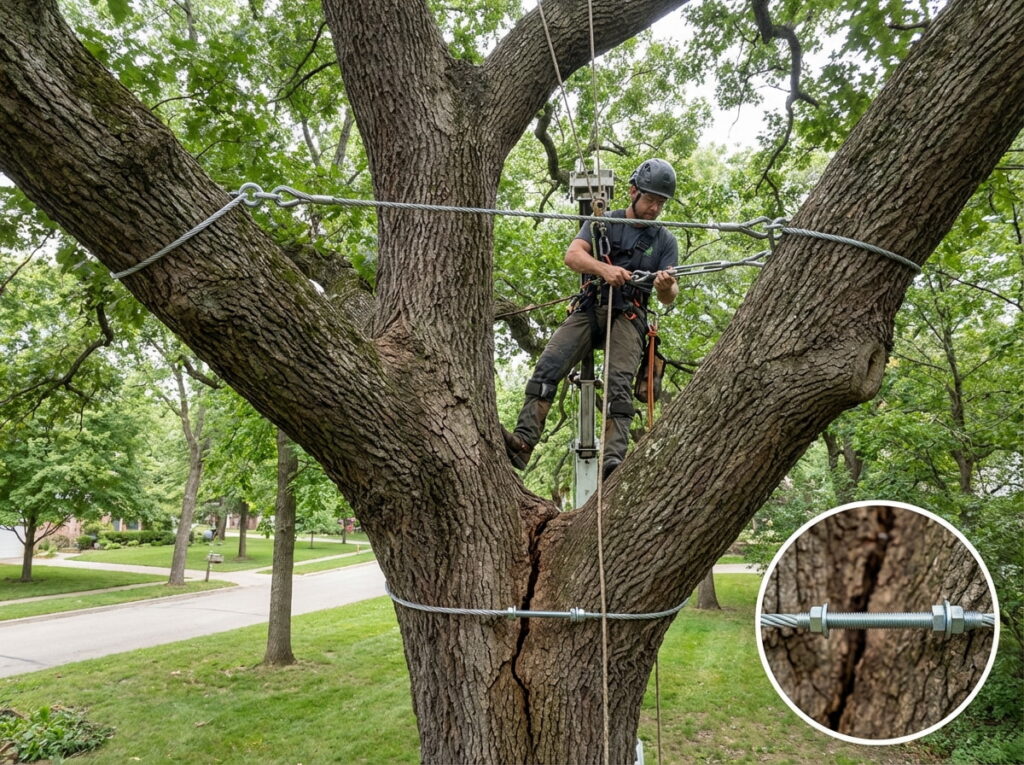
Tree cabling and bracing are support systems installed by arborists to stabilize trees that are structurally compromised. Cabling uses flexible steel cables to connect and limit movement between major limbs. Bracing uses rigid threaded steel rods drilled through weak or splitting stems to hold them together. Used together, they can save a valuable tree that might otherwise need to be removed and they can protect your property from falling limbs in the meantime.
Think about a tree in your yard that you love. Maybe it’s big and old, maybe it shades your whole back patio, maybe your kids climb it. Now imagine you notice the trunk is starting to split down the middle, or two of the main limbs are growing in opposite directions with a crack forming at the joint where they meet.
That’s exactly the kind of situation tree cabling and bracing was designed for. It’s not about making a tree look better, it’s about giving a structurally at-risk tree a fighting chance to keep growing safely for years to come.
This guide explains what cabling and bracing actually is, how it works, when it’s needed, and what the process looks like so you can make an informed decision about your trees.
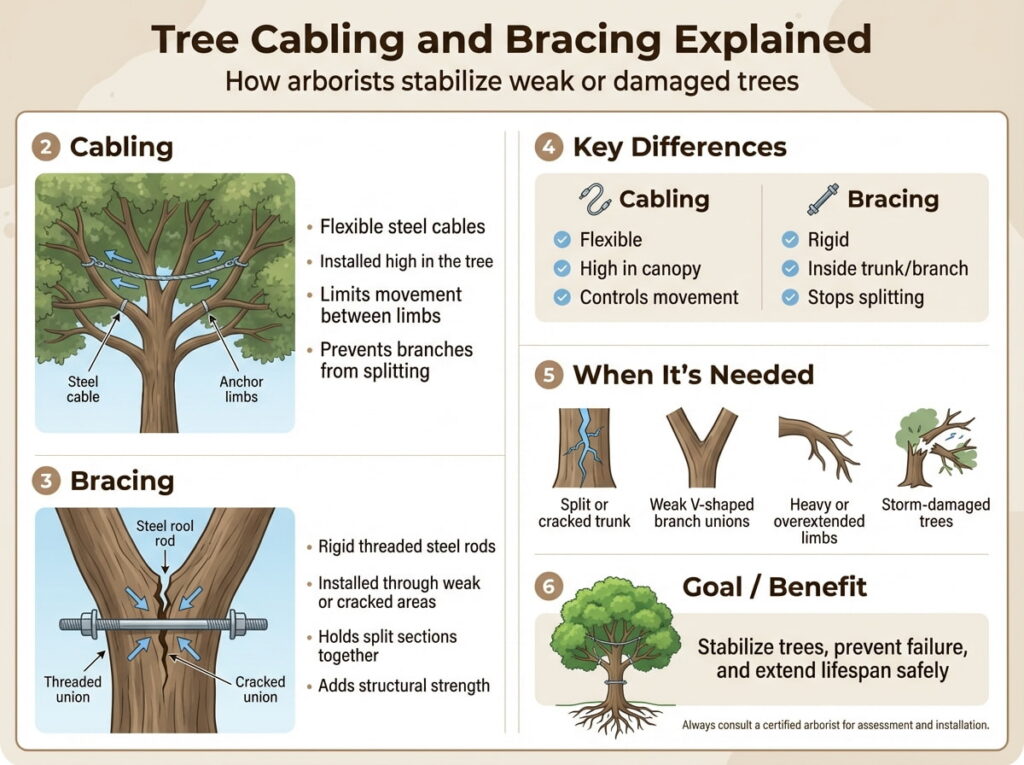
What Is Tree Cabling and Bracing?
Tree cabling and bracing are two related but different techniques used to provide structural support to trees that have a weakness, defect, or damage that puts them at risk of failure.
They’re almost always used together — bracing to hold a damaged area still, and cabling to limit how much the supported branches can move and pull against the repair. But they work differently and address different problems, so it’s worth understanding each one on its own.
| Cabling | Bracing |
| Uses flexible steel cables Installed high in the canopy, connecting two or more limbsAllows some natural movement while limiting how far limbs can spreadBest for: co-dominant stems, heavy overextended limbs, V-crotch unions | Uses rigid threaded steel rods Drilled through weak, split, or cracked stems at the problem areaHolds split sections together so they can’t pull further apartBest for: split trunks, splitting stem junctions, included bark failures |
Does Tree Cabling and Bracing Actually Work?
This is the most honest question to ask, and it deserves an honest answer: yes, when done correctly and for the right tree, cabling and bracing genuinely works. It’s not a gimmick.
Studies and decades of field experience by certified arborists support the effectiveness of properly installed support systems. The International Society of Arboriculture (ISA) and the American National Standards Institute (ANSI) both publish standards for how these systems should be designed and installed, the ANSI A300 Part 3 standard specifically addresses tree support systems.
That said, cabling and bracing is not magic. There are situations where it works well, and situations where it isn’t the right answer.
| When cabling & bracing works well • The tree is otherwise healthy with no significant decay • The structural defect is caught before failure occurs • The defect is limited to one area (stem union, single limb) • The tree has significant value — aesthetic, historical, or ecological • The installation follows ANSI A300 standards• The system is inspected and maintained regularly | When it may not be the right choice • Significant internal decay affects structural integrity • The tree is in advanced decline or poor health overall • Multiple major structural failures are present throughout • Root system is compromised or severely damaged • The tree poses an imminent hazard that cabling alone can’t address • Cost of ongoing maintenance exceeds the tree’s value |
Signs Your Tree Might Need Cabling or Bracing
You don’t need to be an arborist to recognize that something looks off with a tree. These are the warning signs that are worth getting a professional to look at.
- Two or more main stems growing from the same point on the trunk, especially with a tight V-shaped junction.
- A visible crack or split in the trunk or at a major branch union.
- Bark that looks pinched or compressed between two growing stems. (this is included bark — a classic failure point)
- A limb that hangs noticeably lower or appears heavier on one side than the rest of the tree.
- A branch that has partially broken and is being held in place only by the remaining wood or bark.
- A tree that has leaned noticeably after a storm, but the roots appear intact.
- A trunk or limb with a visible cavity or area of decay, especially near a major junction.
- A previously cabled tree whose hardware looks old, corroded, or embedded in bark. (a sign it needs re-inspection)
What Does Tree Cabling and Bracing Cost?
Cost varies quite a bit depending on the tree’s size, the number of defects, how many cables and rods are needed, and how accessible the tree is. That said, here are the general factors that drive the price.
| Cost factor | How it affects the price |
| Tree height and canopy size | Larger trees require longer cables, more robust hardware, and often aerial lift access — all of which add cost |
| Number of cables needed | A simple two-limb cable system costs less than a multi-cable installation on a tree with several structural issues |
| Whether bracing rods are needed | Drilling and threading brace rods adds time and specialized hardware costs |
| Pre-installation pruning | If pruning is needed first (often recommended), this is typically billed separately |
| Site access | Trees in tight spaces or near structures may require aerial equipment or rigging, increasing labor costs |
| Annual inspection | Ongoing inspection costs are part of the long-term commitment and should be factored in from the start |
As a rough ballpark, basic cable installations on a single tree often range from a few hundred dollars to over a thousand, depending on complexity. Bracing adds to that. The best approach is always to get a professional assessment and itemized quote before committing.
Who Should Install Tree Cabling and Bracing?
Tree cabling and bracing must be installed by a certified arborist — ideally one who holds an ISA Certified Arborist credential and is familiar with ANSI A300 Part 3 standards. This isn’t a job for a general landscaper or a handyman with a drill.
Here’s why credentials matter specifically for this type of work.
- Incorrect cable placement can actually make a tree more dangerous, not less, by changing how load is distributed.
- Brace rods drilled in the wrong location or at the wrong angle can cause cracking and accelerate decay.
- Hardware that’s too heavy or too light for the tree’s size and load can fail under the very conditions it was meant to handle.
- An uncertified installer won’t be familiar with ANSI standards and won’t know when cabling is contraindicated.
If a cable system is installed negligently and a limb subsequently falls and injures someone, liability implications are very different than if a certified arborist followed established standards
Frequently Asked Questions
How long does a tree cabling system last?
Hardware-wise, high-quality steel cables and brace rods can last 10–20+ years if properly maintained. The bigger question is whether the system remains appropriate for the tree as it grows and changes. That’s why regular inspection matters more than the longevity of the hardware itself.
Can I install tree cables myself?
Technically possible, but not recommended. Incorrect installation can make a tree more dangerous, damage the tree, or give a false sense of security. The hardware placement, cable tension, and load calculations require knowledge of tree structure and biomechanics that takes years to develop. This is one of those cases where a professional assessment is worth every penny.
Will cabling hurt my tree?
When done correctly by a certified arborist, cabling and bracing causes minimal harm to the tree. The eye bolts and rods do create openings in the wood, but a healthy tree compartmentalizes these wounds over time. The key is proper sizing — hardware that’s too large, or installed in the wrong location, causes more disruption than necessary.
Is cabling the same as topping a tree?
No, they are completely different, and topping is generally harmful while cabling, done correctly, is beneficial. Topping removes large portions of a tree’s canopy indiscriminately. Cabling adds structural support to an existing tree without removing healthy wood. Any arborist who recommends topping as a solution to a structural problem should be viewed with skepticism.