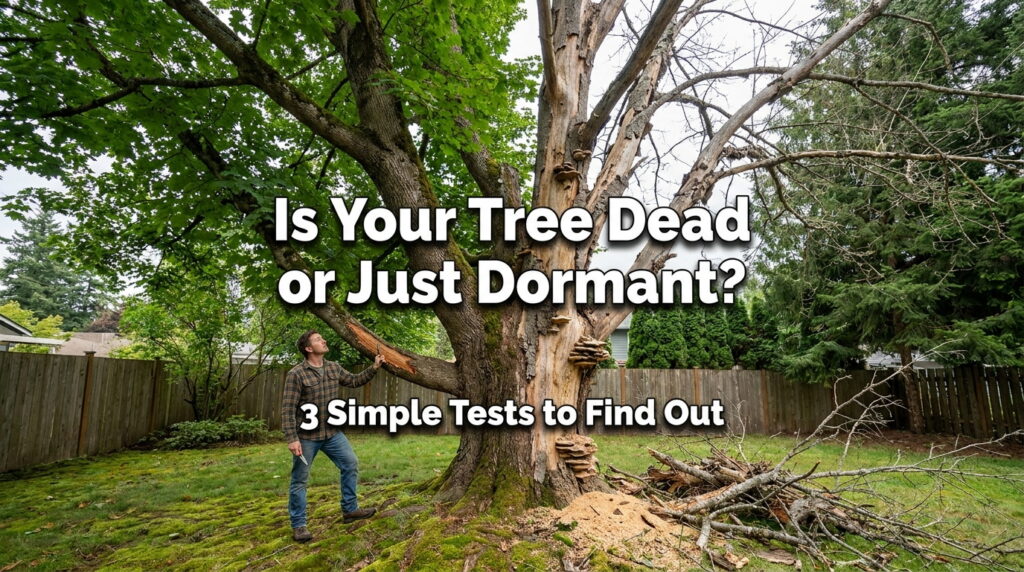
You tell if a tree is dead by scratching the bark on a small branch with your fingernail or a pocket knife. If the layer underneath is green and moist, the tree is alive. If it is brown, dry, and crumbly, that branch is dead. Test several branches in different parts of the tree before you draw any conclusions, because healthy trees can have dead branches and a single failed scratch test does not mean the whole tree is gone.
That is the fastest answer. But the real question most Portland homeowners are asking is not just “is it dead?” It is “is it dead, or is it dormant, or is it dying but still saveable?” Those are three different situations with three different action plans, and getting them confused costs people money. We see it every spring when someone cuts down a perfectly healthy Oregon white oak because it had not leafed out yet (they are late bloomers) and we see it every fall when someone ignores a tree that has been declining for two years because it still has a few green branches.
This guide covers the three diagnostic tests you can do yourself in under five minutes, every visual warning sign that matters, species specific notes for the trees that actually grow in Portland, and what to do once you have your answer.
Dead, Dying, or Dormant? Why the Difference Matters
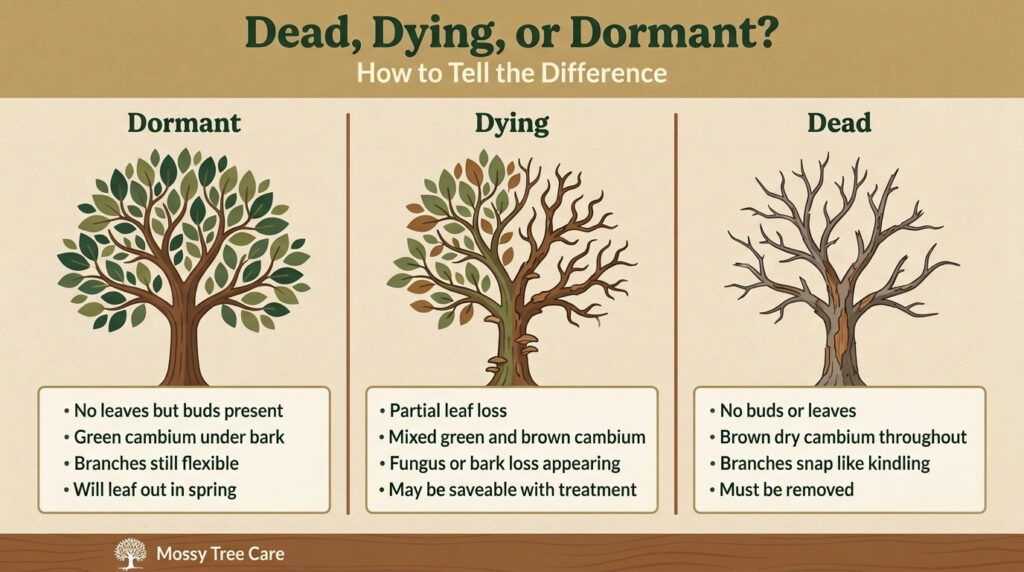
Before you start testing branches, understand what you are actually looking for. These three conditions look similar from a distance but require completely different responses.
Dead means the tree’s vascular system has shut down entirely. No water or nutrients are moving through the trunk. The cambium layer under the bark is brown and dry throughout. The root system is no longer functioning. A dead tree cannot be saved and should be removed before it becomes a safety hazard.
Dying means the tree is in decline but still has some living tissue. You might see green cambium on some branches but not others, or leaves on one side of the canopy but bare branches on the other. A dying tree may be saveable depending on the cause and how far the decline has progressed. This is where a professional arborist’s diagnosis makes the biggest difference, because catching a treatable disease or pest problem early can save a tree that would otherwise be lost.
Dormant means the tree is alive but resting. Deciduous trees in Portland go dormant from roughly November through March, dropping their leaves and suspending growth until spring. A dormant tree looks dead to someone who does not know what to look for, but it will leaf out again when temperatures warm up. The diagnostic tests below will tell you the difference.
Three Tests Every Portland Homeowner Should Know
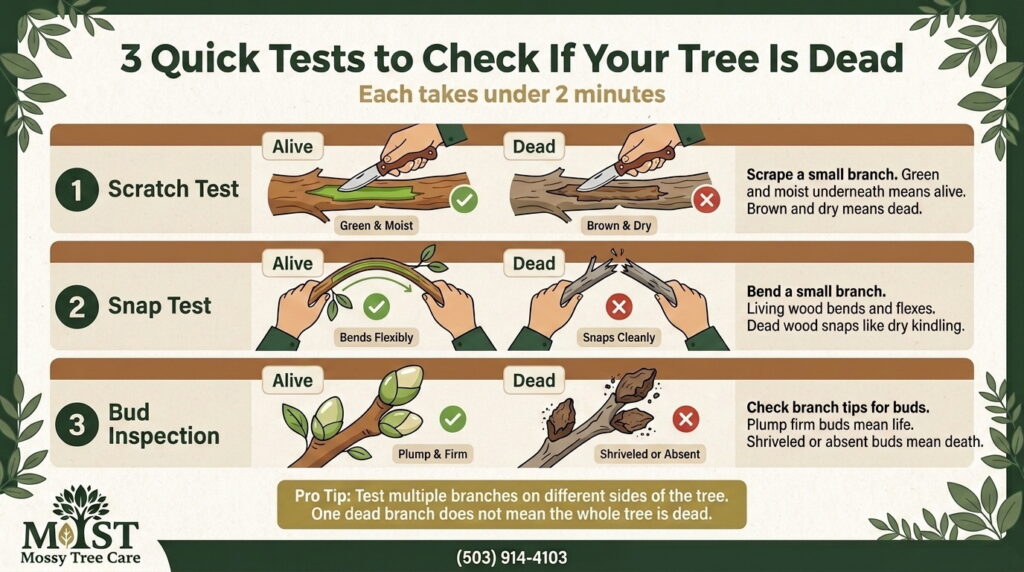
These three hands on tests take less than five minutes and will tell you whether a tree or branch is alive. Use all three together for the most reliable answer. No single test is conclusive on its own.
The Scratch Test (Cambium Check)
This is the most reliable DIY diagnostic for tree health. Use your fingernail or a small pocket knife to gently scrape away a thin layer of outer bark on a small branch or twig.
What you are looking for: The cambium layer directly under the bark. On a living tree, this layer is bright green and moist. On a dead tree, it is brown, tan, or gray and feels dry or crumbly.
How to do it right: Start with twigs and small branches at different heights and on different sides of the tree. Scratch a spot about the size of a quarter. If you get green on most branches, the tree is alive. If every branch you test comes back brown and dry, the tree is likely dead.
Portland note: Bark thickness varies dramatically between species in our area. Douglas fir has thick, deeply furrowed bark that requires a knife to scratch through, while bigleaf maple has thinner bark that you can often test with just a fingernail. On thick barked species, scratch a younger branch higher up rather than trying to cut through the main trunk.
One caution: Portland’s wet climate can sometimes keep the outer bark moist on a recently dead tree, which can be misleading. Always combine this test with the snap test and bud inspection for a complete picture.
The Snap Test (Branch Flexibility)
Grab a small branch or twig with both hands about six inches apart and gently bend it.
Living branch: Bends and flexes without breaking, or breaks slowly with visible green fibers inside.
Dead branch: Snaps cleanly and easily with a dry crack, revealing gray or brown wood inside with no moisture.
Test branches from multiple areas of the tree. A few dead twigs at the tips are normal, especially after winter storms. What you are looking for is a pattern. If branches throughout the canopy snap like dry kindling, the tree has a serious problem.
Seasonal note: Branches lose some flexibility during Portland’s cold snaps in December and January. If you are testing during a freeze, wait for temperatures to rise above 40 degrees for a more accurate result. By late February or early March, living branches should flex noticeably even on cold days.
The Bud Inspection Test
This test works best from late winter through early spring, right before leaf out season.
Examine the tips of branches for buds. Living dormant trees produce buds in preparation for spring growth. These buds should look plump, firm, and intact, sometimes with a slightly glossy appearance. The color varies by species. Bigleaf maple buds are green to reddish brown. Oregon white oak buds are clustered and reddish. Douglas fir buds are pointed and reddish brown.
Dead trees produce no buds at all, or the buds are shriveled, dry, and crumble when you touch them. If you gently pull a bud and it comes off with no resistance, that branch is dead.
Portland timing tip: Different species in our area break dormancy at different times. Bigleaf maple is one of the earliest, often showing new growth in late February or early March. Oregon white oak is one of the latest, sometimes waiting until late April or even early May to leaf out. Do not assume an oak is dead just because it is bare in early April when the maples around it are already green. Compare your tree to other trees of the same species in your neighborhood before making a judgment.
Visual Warning Signs of a Dead or Dying Tree
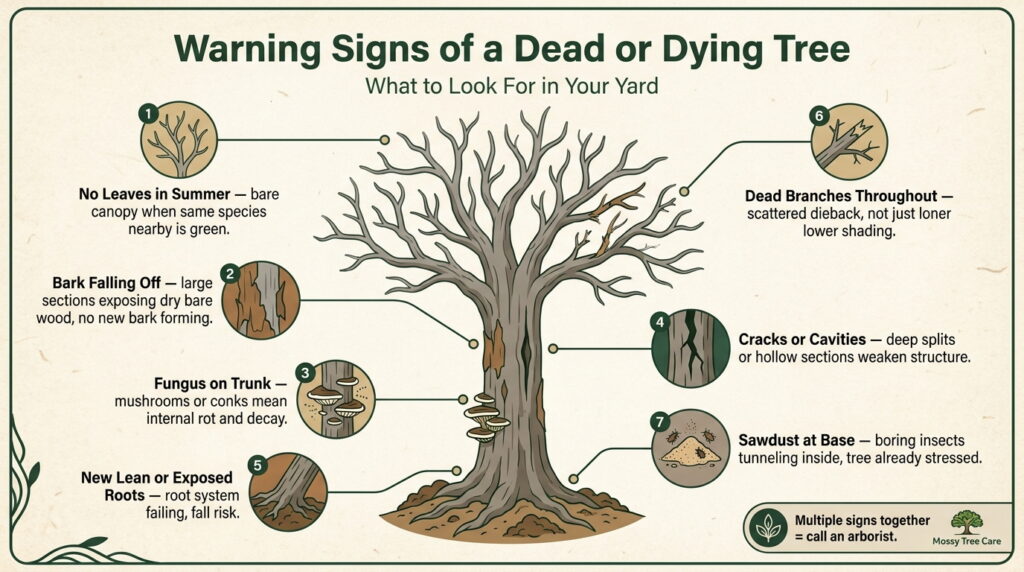
Beyond the hands on tests, these visual cues can signal serious problems from across the yard. Any single sign warrants a closer look. Multiple signs together usually mean the tree is in real trouble.
No Leaves During Growing Season
By late May, every deciduous tree in the Portland area should be showing leaves. If your tree is still bare when the same species in your neighborhood is fully leafed out, something is wrong. A few bare branches could mean localized damage. An entirely bare canopy during summer means the tree is either dead or severely compromised.
One sided leaf loss is a specific warning sign. If half the canopy is green and the other half is bare, you are likely looking at root damage, a vascular disease, or soil compaction on one side of the tree. This pattern sometimes shows up after nearby construction or utility work that cut through roots on one side.
Bark Falling Off in Large Sections
Healthy trees continuously shed and replace bark as part of their natural growth cycle. What is not normal is large sheets of bark falling away to reveal bare, dry wood underneath with no new bark forming behind it.
Important Portland exception: Pacific madrone naturally sheds its outer bark in papery sheets, revealing smooth green or reddish bark underneath. This is completely normal and is actually one of the tree’s most distinctive features. The difference is that healthy madrone bark peels to reveal fresh, living bark, while a dying tree’s bark falls away to expose dry, dead wood. If you are unsure, the scratch test on the exposed wood will give you a definitive answer.
Birch trees also shed bark naturally, but again, healthy shedding reveals fresh bark beneath, not bare wood.
Fungus or Mushrooms on the Trunk
Mushrooms, shelf fungus (conks), or other fungal growth on the trunk or at the base of a tree is one of the most serious warning signs. Fungi feed on dead or decaying wood, and their presence usually means significant internal rot that you cannot see from outside.
What to look for in Portland: Turkey tail fungus (Trametes versicolor) is extremely common in the Pacific Northwest and grows on dead wood. If you see its distinctive fan shaped brackets with concentric color bands growing on your tree’s trunk, the wood underneath is dead or actively decaying. Honey mushrooms (Armillaria) are another serious concern in Portland. They attack living roots and can kill otherwise healthy trees. You will often see clusters of honey colored mushrooms at the base of the tree in fall, right around October and November in our area.
Portland’s wet winters and mild temperatures create ideal conditions for fungal growth. A tree that shows no fungus in summer may develop visible fruiting bodies after the fall rains start. Check the base of your trees in October and November when conditions are right for mushrooms to appear.
Leaning Trunk or Exposed Roots
A tree that has always grown at a slight angle is not necessarily a problem. What is concerning is a new lean that was not there before, especially if you can see soil heaving or roots pulling up on one side. This means the root system is failing and the tree is at risk of falling.
In Portland, sudden leaning often shows up after the heavy rain and wind events we get between November and February. Saturated soil loosens root systems, and sustained winds from the southwest can push compromised trees past their tipping point. A tree that developed a new lean after a winter storm should be evaluated by an arborist before the next storm season.
Cracks, Cavities, or Hollow Sections
Vertical cracks running along the trunk expose the tree’s interior to insects, moisture, and fungal infection. Small surface cracks are common and often heal on their own, but deep cracks that extend into the heartwood or widen over time indicate structural weakness.
Cavities and hollow sections reduce the tree’s ability to support its own weight. A tree can survive with some internal hollowing (many old growth trees in the Pacific Northwest are hollow to some degree) but large cavities in the main trunk or major limbs create failure points. If you can fit your fist into a trunk cavity, get a professional assessment.
Dead Branches Throughout the Canopy
Individual dead branches are a normal part of a tree’s life cycle. What matters is the pattern. If dead branches are scattered throughout the canopy (not just at the bottom where natural shading causes lower branch dieback), the tree may be dying from the top down.
Arborists call large dead branches “widow makers” because they can fall without warning and cause serious injury. If you see dead branches thicker than two inches hanging in the canopy, especially over walkways, driveways, or where your kids play, do not wait for a full tree assessment. Get those branches removed immediately.
Sawdust or Insect Activity at the Base
Fine sawdust (called frass) piled at the base of a tree is evidence of boring insects tunneling inside. In the Portland area, the most common culprits are carpenter ants and various bark beetles. These insects typically attack trees that are already stressed or dying, so their presence is both a symptom and an accelerator of decline.
Look for small exit holes in the bark, piles of sawdust around the trunk base, and sap oozing from holes higher up the trunk. Heavy insect activity combined with other decline signs usually means the tree is beyond saving.
Common Portland Tree Species: What to Watch For
Not every tree in Portland behaves the same way. Here are species specific notes for the trees you are most likely to be evaluating in the metro area.
Douglas Fir
Douglas fir is an evergreen, so it should carry green needles year round. If you see large sections of brown or orange needles that are not falling off, the tree is either dead or severely stressed. Normal needle drop happens on interior branches and older needles, not at the branch tips.
Swiss needle cast is the most common disease affecting Douglas fir in western Oregon. It causes needles to yellow and drop prematurely, leaving trees thin and sparse. Look for tiny black dots on the underside of needles with a hand lens. Swiss needle cast rarely kills trees outright but can severely weaken them over many years, making them vulnerable to other problems.
The scratch test on Douglas fir requires a knife because the bark on mature trees is thick and deeply furrowed. Test younger branches higher up in the tree where the bark is thinner.
Western Red Cedar
Western red cedar naturally develops brown interior foliage in summer and fall, especially during dry years. This is the tree shedding older growth and is not a sign of death. The brown foliage should be on interior branches, not the tips.
If the entire tree is turning brown from the top down, that is a different situation. Top dieback in western red cedar in Portland is often caused by drought stress during our increasingly dry summers. A tree that browses out from the top during August may recover with deep watering, or it may be too far gone. The scratch test on green tipped branches will tell you which.
Bigleaf Maple
Bigleaf maple is one of the first trees to leaf out in spring and one of the first to show stress. Tar spot (a fungal disease that causes black blotches on leaves) is extremely common in Portland and looks alarming but is mostly cosmetic and does not kill the tree.
More concerning is when a bigleaf maple fails to leaf out by mid March or shows wilting, curling leaves during the growing season. Bigleaf maples have relatively thin bark, making the scratch test easy. They are also prolific resprouters, so even a severely stressed maple may send up suckers from the base or trunk. Suckers from the base while the canopy is dying is actually a sign of severe stress, not recovery. The tree is redirecting its last resources into survival shoots.
Oregon White Oak
Oregon white oak is a protected species in many parts of the Portland metro area, and misidentifying a dormant oak as dead can lead to unnecessary removal (and potential permit violations). Oaks are among the last trees to leaf out in spring, often waiting until late April or early May. Do not judge an oak’s health before May.
When Oregon white oak does die, it often dies slowly from the tips inward. Look for dead branch tips with no buds by late May, and test progressively larger branches working your way back toward the trunk. If the main trunk still shows green cambium, the tree may be saveable with proper care.
Oak wilt is not currently a major problem in Oregon, but it is worth monitoring. If an oak drops its leaves suddenly in summer (not the gradual browning of fall), contact an arborist for evaluation.
Pacific Madrone
As mentioned above, madrone naturally sheds bark. This is not a problem. What is a problem is when the tree develops cankers (sunken, discolored areas) on the trunk or branches, or when leaves turn brown and curl during the growing season.
Madrone leaf blight is common in Portland’s wet springs and causes brown, curled leaves. The tree usually recovers once dry weather arrives. But if the cankers are spreading and the tree is losing branches, it may be in serious decline. Madrone is notoriously difficult to treat once it starts declining, because it does not respond well to pruning or transplanting.
Can You Save a Dying Tree?
If your tests show the tree is dying (some living tissue, some dead), the answer depends on what is causing the decline and how far it has progressed.
Treatable causes include improper watering (both too much and too little), soil compaction around roots (common after construction), minor pest infestations caught early, nutrient deficiencies that can be corrected with soil amendments, and some fungal diseases if treated before they spread throughout the tree.
Difficult or impossible to treat include advanced root rot, structural damage from storms or construction that severed major roots, severe boring insect infestations that have compromised the vascular system, and diseases like sudden oak death (Phytophthora ramorum) which is currently found in Curry County and nurseries statewide but not in Portland’s wildlands.
What a professional arborist actually does that you cannot do at home: an ISA certified arborist can perform a root collar excavation to check for girdling roots and root rot, use a resistograph (a drill that measures wood density) to detect internal decay that is invisible from outside, identify specific diseases and pest species that require targeted treatment, and develop a multi season treatment plan that addresses the underlying cause rather than just the symptoms.
When to Remove a Dead Tree (and When to Leave It)
Not every dead tree needs to come down immediately, and some probably should not come down at all.
Remove immediately when the tree is leaning toward a structure, power line, or high traffic area. When large dead branches hang over walkways, driveways, or play areas. When the trunk shows significant cracking, hollowing, or structural weakness. When the tree is in a neighborhood where falling would block roads or damage neighboring property. These are emergency tree removal situations.
Schedule removal when the tree is dead but structurally sound, standing upright with no lean, and not positioned over anything that would be damaged if it fell. You have time to get quotes, check permit requirements, and plan the work. Most dead trees remain standing for months or even years before they become immediate hazards, though their condition deteriorates over time.
Consider leaving it when the tree is in a wooded area away from structures and foot traffic. Dead standing trees (called snags) provide critical habitat for woodpeckers, owls, bats, and dozens of other species. In Portland, properties in environmental overlay zones may actually require preserving snags as wildlife habitat. If the dead tree is not a safety risk, leaving it standing is the most ecologically responsible option.
Portland Tree Removal: Permits, Costs, and What to Expect
Do You Need a Permit?
In Portland, trees 12 inches or larger in diameter (measured at 4.5 feet above ground) require a removal permit from the city, even if the tree is dead. Street trees require a permit regardless of size. Heritage trees have additional protections.
The permits are currently fee free, funded by Portland’s Clean Energy Community Benefits Fund, so there is no cost to apply. But removing a regulated tree without a permit can result in significant fines.
Contact Portland Urban Forestry at 503-823-8733 or trees@portlandoregon.gov before removing any large tree. You can check whether a tree is on your property or in the public right of way through PortlandMaps.
What Does Dead Tree Removal Cost in Portland?
The cost depends on the tree’s size, location, and condition.
Small trees (under 30 feet) typically cost $300 to $800 for removal including stump grinding.
Medium trees (30 to 60 feet) run $800 to $1,800 depending on access and proximity to structures.
Large trees (over 60 feet) can cost $1,500 to $3,500 or more, especially if the tree requires specialized equipment like a crane or bucket truck.
Dead trees can actually be more expensive to remove than living trees because the wood is brittle, unpredictable, and more likely to break during the removal process. A dead tree that a climber would normally ascend may require a crane instead because the wood cannot safely support climbing equipment.
If cost is a concern, get quotes from at least three licensed tree services. Look for Oregon CCB licensing and verify insurance before hiring anyone.
Frequently Asked Questions
How long can a dead tree stand before it falls?
It depends on the species, size, and cause of death. A dead Douglas fir with intact roots can stand for years because the resinous wood resists decay. A dead bigleaf maple in Portland’s wet climate may begin losing major branches within six months as the soft wood decays rapidly. As a general rule, do not assume a dead tree is safe just because it is still standing. The longer it stands, the less predictable its failure becomes.
Can a dead tree come back to life?
No. Once a tree is truly dead (all cambium brown and dry, no buds, no green tissue anywhere), it cannot recover. However, some trees that appear dead are actually dormant or stressed and will recover on their own or with treatment. This is why the diagnostic tests above matter. Do not cut down a tree until you have confirmed it is actually dead, not just dormant or stressed.
Is a dead tree covered by homeowners insurance?
Generally, homeowners insurance covers damage caused by a fallen tree (to your home, car, or other structures) but does not cover the cost of removing a dead tree before it falls. If you know a tree is dead and it damages your neighbor’s property, your liability exposure increases because you were aware of the hazard. This is one of the strongest financial arguments for prompt dead tree removal.
Do I need a permit to remove a dead tree in Portland?
Yes, if the tree is 12 inches or larger in diameter. Portland requires removal permits for all regulated size trees regardless of whether they are alive or dead. Street trees require permits regardless of size. The permits are free to apply for. Contact Portland Urban Forestry at 503-823-8733.
How much does it cost to remove a dead tree in Portland?
Dead tree removal in the Portland metro area runs $300 to $3,500 depending on size, location, and complexity. Small trees under 30 feet are $300 to $800. Medium trees are $800 to $1,800. Large trees over 60 feet are $1,500 to $3,500 or more. Dead trees can cost more than living tree removal because the brittle wood is less predictable during the process.
What is the fastest way to tell if a tree is dead?
The scratch test takes about 30 seconds. Scrape a small area of bark on a branch with your fingernail or pocket knife. Green, moist tissue underneath means the branch is alive. Brown, dry tissue means it is dead. Test multiple branches in different areas of the tree for a complete picture.
When should I call an emergency arborist?
Call for emergency tree service when a dead or dying tree is actively leaning toward your home or a structure, when large dead branches are hanging directly over occupied areas, when a dead tree has partially fallen and is resting against power lines or another tree, or after storm damage has left a tree unstable. Do not attempt to remove a hazardous tree yourself.