You kill a tree or stump by cutting it close to the ground and applying a concentrated herbicide like triclopyr or glyphosate to the exposed cambium layer within 15 minutes of cutting. That narrow window matters because the fresh cut actively draws the chemical down into the root system. Wait too long and the wood seals over, the herbicide sits on the surface, and the tree pushes new growth within weeks.
That is the professional method, and it works on almost every species we deal with in the Portland area. But it is not the only option, and it is not always the right one. Some trees respond better to salt treatments. Some stumps are small enough to dig out by hand. And some methods people find online, like pouring bleach or diesel fuel on a stump, do nothing but contaminate your soil.
This guide covers every method that actually works, the ones that don’t, and what Portland homeowners specifically need to know about tree removal regulations and burn restrictions before they start.
How to Kill a Standing Tree
Sometimes a tree needs to go but you can’t fell it right away. Maybe it is growing into a power line, leaning toward your house, or it is an invasive species that will keep spreading if you just cut it down. In those cases, you want to kill the tree first, let it dry out, and then remove it safely.
Cut Surface Method (Most Effective)
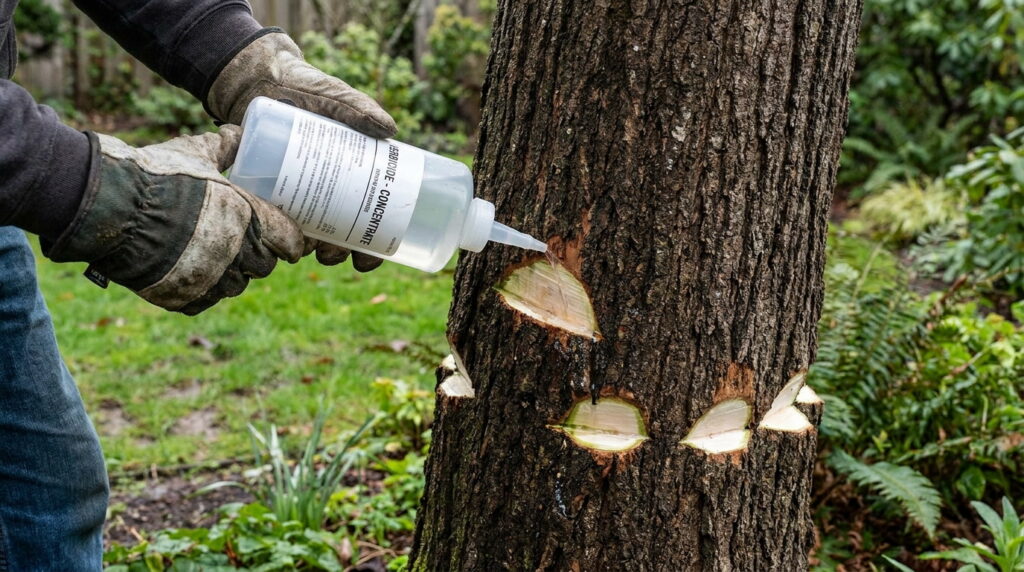
Make a series of downward cuts into the bark and outer sapwood near the base of the tree using a hatchet or hand axe. These cuts should go through the bark and about an inch into the wood. Space them every two to three inches around the trunk, creating a ring of exposed wood.
Pour undiluted triclopyr or glyphosate concentrate directly into each fresh cut. The tree’s vascular system will pull the chemical down into the roots. Do this in late summer or early fall when the tree is moving energy downward toward its root system for winter storage. Spring works too, but avoid midsummer when the tree is actively pushing sap upward.
Girdling (No Chemicals)
Girdling means removing a complete ring of bark and cambium from around the trunk. Use a draw knife or hatchet to strip a band four to six inches wide, all the way around, cutting deep enough to expose the white sapwood underneath. This severs the connection between the crown and the roots.
The tree will die over the course of one to two growing seasons. It is slower than herbicide, but it uses no chemicals at all, which matters if you are near a vegetable garden, a stream, or anywhere runoff is a concern. In Portland, that includes properties near Johnson Creek, Fanno Creek, or any tributary feeding the Willamette River.
Basal Bark Treatment
For trees under six inches in diameter, you can skip the cutting entirely. Mix a triclopyr ester product with a bark oil carrier and paint it around the bottom 12 to 18 inches of the trunk. The chemical penetrates through the bark and kills the cambium underneath.
This method works year round, even in winter, which makes it especially useful in Oregon where the rain keeps you out of the yard for months at a time. It is the standard approach for killing invasive species like tree of heaven and English holly, both of which are serious problems in the Portland metro area.
Portland’s Invasive Tree Problem
If the tree you want to kill is an invasive species, you are doing your neighborhood a favor by removing it. But you also need to be more aggressive with your approach, because many invasive species resprout aggressively from roots and stumps.
Tree of heaven (Ailanthus altissima) is one of the worst. It spreads through root suckers and can send up new shoots 50 feet from the original trunk. Cutting it down without treating the stump with herbicide will make the problem worse, not better. The cut surface method with triclopyr is the only reliable approach according to Oregon State Extension.
English holly (Ilex aquifolium) is classified as an invasive species in the Pacific Northwest. Birds spread the seeds into forest edges and natural areas throughout the Willamette Valley. Pull small seedlings when the soil is wet. For larger trees, cut and immediately treat the stump with glyphosate.
Norway maple (Acer platanoides) creates such dense shade that nothing grows underneath it, and it spreads aggressively into natural areas. It looks similar to native bigleaf maple, but you can tell them apart by breaking a leaf stem. Norway maple has milky white sap. Bigleaf maple has clear sap.
How to Kill a Tree Stump
You cut down the tree, but the stump is still alive and pushing out new shoots. Here is how to finish the job, from fastest to most natural.
Chemical Treatment (Fastest)
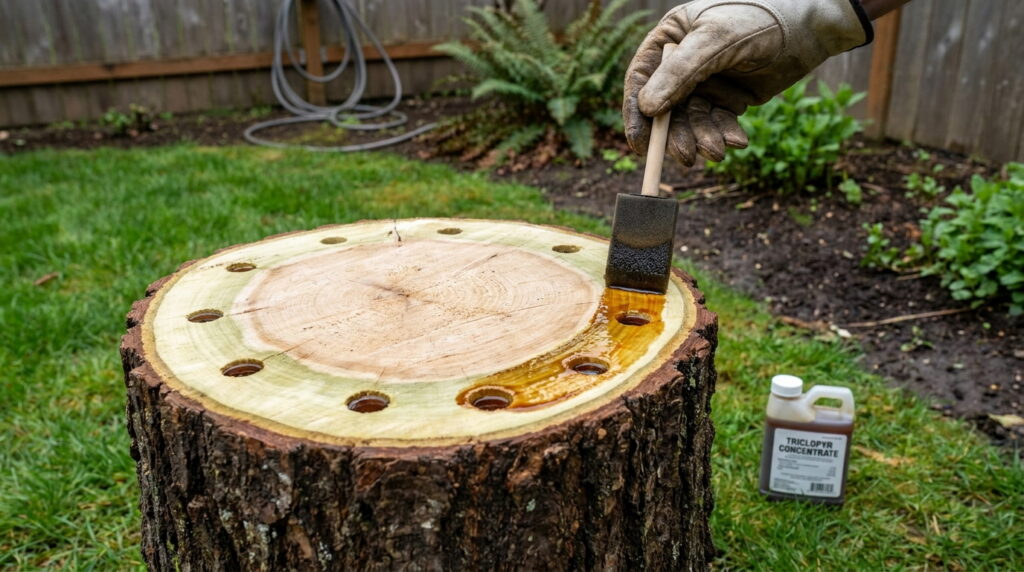
Cut the stump as close to the ground as you can with a chainsaw. Within 15 minutes of cutting, brush a concentrated herbicide directly onto the outer ring of the stump. That outer ring, the cambium layer, is the only part that is alive. Painting the entire stump face wastes product. Focus on the outer one to two inches.
For most tree species in the Portland area, triclopyr (sold as Garlon or Crossbow) works better than glyphosate for stump treatment. Triclopyr is specifically designed for woody plants, while glyphosate is a general vegetation killer. The National Pesticide Information Center at Oregon State University has detailed safety data on both.
Drill five to ten holes into the top of the stump, each about one inch wide and three to four inches deep, concentrating on the outer ring. Fill the holes with undiluted herbicide. This gives the chemical more surface area to work with and speeds up root death.
Timing matters. Treat stumps in late summer through fall for best results. The tree is actively pulling nutrients (and herbicide) down into the root system for winter storage. Spring treatment works but is slightly less effective. Avoid treating in the middle of summer when sap flow is upward.
Check the stump every few weeks during the growing season. If you see new sprouts (suckers), cut them off and spray the fresh cuts with herbicide. Some species, especially maples and elms, are persistent resprouters and may need two to three rounds of treatment.
Epsom Salt or Rock Salt
Drill holes into the stump the same way you would for herbicide. Fill them with Epsom salt (magnesium sulfate) or rock salt (sodium chloride), then add water to dissolve the salt. Cover the stump with a tarp or plastic sheet to keep rain from washing the salt out.
This method takes six to twelve months to fully kill the stump and begin decomposition. It is slower than herbicide, but it costs under $20 and uses no synthetic chemicals.
The trade off nobody mentions: Rock salt in particular can contaminate the surrounding soil and kill nearby plants. If you have a garden bed, lawn, or other trees within six feet of the stump, use Epsom salt instead. Epsom salt breaks down into magnesium and sulfur, both of which are actually beneficial to soil in moderate amounts. Rock salt adds sodium, which most plants cannot tolerate.
Tarping and Light Deprivation
Cover the stump completely with a heavy black tarp or thick black plastic. Weight the edges with rocks or soil so no light gets through. Without sunlight, the stump cannot photosynthesize, and any new sprout growth dies back. Over six months to a year, the stump weakens and begins to decay.
This is the most hands off approach, but it only works on stumps that are already cut close to the ground. If the stump is more than a few inches tall, cut it lower first. And be realistic about the timeline. In Portland’s wet climate, decomposition under a tarp happens faster than in dry climates, but you are still looking at a minimum of six months before the stump is soft enough to break apart.
Stump Grinding (Immediate Results)
A stump grinder is a machine with a spinning carbide-tipped wheel that chews the stump into wood chips, grinding it down six to twelve inches below the soil surface. This is the fastest physical removal method and the one we use most often on tree care jobs in Portland.
You can rent a stump grinder for $150 to $300 per day from most equipment rental shops in the Portland metro area. Professional grinding runs $100 to $400 per stump depending on size and accessibility.
Before you grind: Call 811 at least two business days before grinding to have underground utilities marked. Stump grinders cut 6 to 12 inches below grade, which is deep enough to hit gas lines, irrigation pipes, and buried electrical conduit.
Grinding does not kill the root system. Large lateral roots will still be alive underground and may send up sucker shoots for a season or two. If the tree was a prolific sprouter (maple, elm, poplar), consider treating the stump with herbicide before grinding, or be prepared to cut suckers as they appear.
Digging Out Small Stumps
For stumps under 12 inches in diameter, manual removal is often the simplest option. We have a step by step guide to removing small tree stumps that walks through the full process with a shovel, mattock, and pry bar.
The short version: dig a trench around the stump to expose the major roots. Cut each root with a pruning saw or reciprocating saw. Once the lateral roots are severed, lever the stump out with a pry bar or digging bar. Small stumps usually come out in under an hour of work.
Methods to Avoid
Not everything you read online works, and some methods cause more problems than the stump itself. Here is what we tell homeowners to skip.
Bleach. It will not kill a mature stump. The root system is too extensive for a surface application of household bleach to reach. Worse, bleach raises soil pH and kills the beneficial organisms that help soil stay healthy. You end up with a live stump and dead soil around it.
Motor oil or diesel fuel. Neither one is an effective herbicide. Diesel can help ignite a stump for burning, but soaking a stump in motor oil is an environmental hazard, not a stump killer. Both contaminate soil and can leach into groundwater. In the Portland area, where many residential lots drain toward urban streams, this is especially irresponsible.
Copper nails. This is one of the most persistent myths in tree care. The theory is that hammering copper nails into a stump introduces toxic amounts of copper that kill the wood. In reality, a few nails introduce a negligible amount of copper relative to the mass of even a small stump. Studies have never demonstrated this method working on mature stumps.
Foliar spray on a standing tree. Spraying Roundup or brush killer on the leaves of a tree you want to kill will damage the foliage but rarely kills the root system. The tree drops the poisoned leaves, grows new ones, and keeps going. Foliar herbicide works on weeds and brush, not on established trees with deep root systems.
Burning (in Portland). Oregon’s Department of Environmental Quality prohibits open burning inside the Urban Growth Boundary, which covers virtually all of Portland, Beaverton, Gresham, Lake Oswego, and the surrounding metro area. Even outside the UGB, you need a burn permit from your local fire district, and you can only burn during designated burn seasons. Burning a stump in your Portland backyard is illegal, period. If you live in a rural area outside the UGB, check with your county and fire district before attempting a stump burn.
Portland Tree Removal: Permits and Regulations
Before you kill any tree on your property, know the rules. Portland has some of the strictest tree protection regulations in the country.
Private trees 12 inches in diameter or larger (measured at 4.5 feet above the ground) require a removal permit from the City of Portland. As of July 2025, these permits are fee free, funded by Portland’s Clean Energy Community Benefits Fund. But you still need the permit before you cut.
Street trees (any tree in the public right of way) require a permit regardless of size. You cannot kill, remove, or significantly prune a street tree without city approval, even if it is directly in front of your house.
Heritage trees have additional protections. Removing a heritage tree without approval carries significant fines.
Environmental overlay zones have their own rules. If your property falls within an environmental zone or plan district, permits may be required for trees of any size.
The bottom line: if the tree is over 12 inches in diameter, get a permit first. Contact Portland Urban Forestry at 503-823-8733 or trees@portlandoregon.gov. If you are not sure whether the tree is on your property or in the right of way, check PortlandMaps before you start cutting.
How Much Does Stump Removal Cost?
The cost depends on the method and the size of the stump.
DIY chemical treatment runs $10 to $30 for herbicide or salt. It is the cheapest option but takes weeks to months to fully work.
Stump grinder rental costs $150 to $300 per day in the Portland metro area. You will also need a truck or trailer to transport the grinder. Most homeowners can grind two to four small stumps in a day.
Professional stump grinding runs $100 to $400 per stump depending on diameter, root spread, and accessibility. If the stump is in a tight backyard with no equipment access, expect to pay toward the higher end.
Full tree removal with stump grinding through a licensed tree service typically runs $500 to $2,500 in the Portland area depending on tree size, location, and complexity. This includes felling, limb removal, debris hauling, and grinding the stump below grade.
When to DIY vs When to Call a Professional
Handle it yourself if the stump is under 12 inches in diameter, you have clear access, there are no utilities nearby, and you are comfortable using a chainsaw or hand tools. Chemical treatment of small stumps is straightforward and effective.
Call a professional when:
The tree is still standing and over 20 feet tall. Felling a large tree near structures, power lines, or other trees requires professional equipment and training. This is consistently one of the most dangerous jobs in arboriculture.
The stump is over 18 inches in diameter. Large stumps have extensive root systems that make DIY removal impractical and stump grinder rental risky for inexperienced operators.
The tree is an invasive species with aggressive root suckering. Tree of heaven, black locust, and similar species require follow up treatment over multiple seasons. A professional can set up a treatment plan that actually eliminates the root system rather than triggering an explosion of new shoots.
The stump is near your foundation, retaining wall, or sewer line. Grinding or digging near structures can cause expensive damage if you don’t know exactly what is underground.
You need an emergency tree removal after storm damage. A partially fallen tree is unstable and unpredictable. Do not attempt to cut or remove it yourself.
Frequently Asked Questions
Will salt kill a tree stump?
Yes, but slowly. Both Epsom salt (magnesium sulfate) and rock salt (sodium chloride) will kill a stump over six to twelve months when packed into drilled holes and kept moist. Epsom salt is the safer choice because it breaks down into nutrients that benefit surrounding soil. Rock salt can sterilize the soil around the stump and kill nearby plants, so avoid it if you plan to garden in that area.
How long does it take for a stump to rot on its own?
An untreated stump can take 3 to 10 years to fully decompose, depending on the species, size, and climate. Softwoods like pine and fir rot faster than hardwoods like oak and maple. Portland’s wet winters actually speed up decomposition compared to drier climates, but you are still looking at years, not months, without intervention.
Can I burn a tree stump in Portland, Oregon?
No. Oregon DEQ prohibits open burning inside the Urban Growth Boundary, which covers Portland and the surrounding metro area. Burning a stump in your yard is illegal and can result in fines from both DEQ and Portland Fire & Rescue. If you live in a rural area outside the UGB, you may be able to burn with a permit from your local fire district, but only during designated burn seasons.
What is the fastest way to kill a tree stump?
Stump grinding gives you immediate results in a single day. If you want to kill the stump chemically rather than grind it out, applying concentrated triclopyr to a freshly cut stump surface will kill the root system in four to eight weeks. The key is treating the stump within 15 minutes of cutting, before the wood seals over.
Do copper nails actually kill trees?
No. This is a persistent myth. A few copper nails introduce far too little copper to affect a tree with a root system weighing hundreds or thousands of pounds. No peer reviewed research has ever demonstrated copper nails reliably killing a tree or stump. Use a proven method instead.
When should I call a professional for stump removal?
Call a professional when the tree is still standing and taller than 20 feet, when the stump is over 18 inches in diameter, when the tree is near power lines or structures, or when you are dealing with an invasive species that requires follow up treatment. Professional tree services carry insurance, use commercial grade equipment, and can handle complex removals that put homeowners at risk.
Is it illegal to kill a tree on my own property in Portland?
Not necessarily, but you may need a permit. In Portland, trees 12 inches or larger in diameter (measured at 4.5 feet tall) require a removal permit from the city. Street trees require permits regardless of size. Heritage trees have additional protections. The permits are currently fee free, so there is no cost to apply, but removing a regulated tree without a permit can result in fines. Contact Portland Urban Forestry at 503-823-8733 before removing any large tree.
This guide was written by the tree care professionals at Mossy Tree Care, Last updated September 2026.