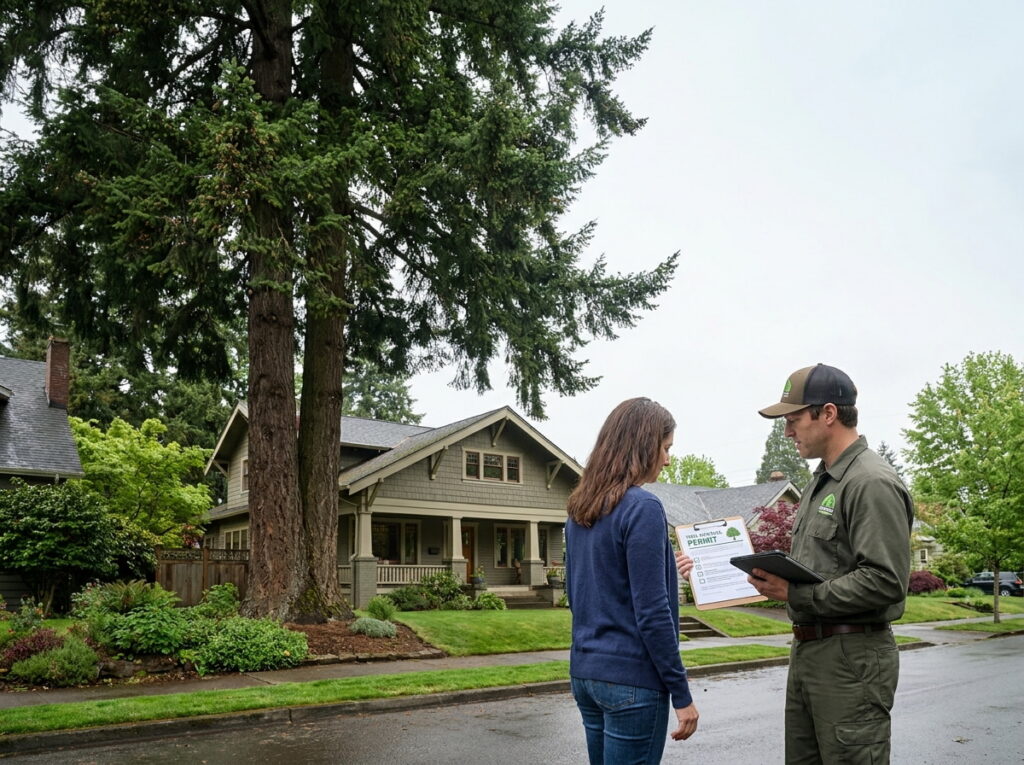
The most expensive mistake a homeowner can make with a tree isn’t hiring the wrong crew. It’s cutting down a tree that the city considered protected — and finding out afterward.
Permit rules in the Portland metro are not consistent. Cross a street in some neighborhoods and the rules change entirely. A 14-inch maple that needs no paperwork in one city can require a posted notice, a public comment period, and two replacement trees in the next. Nobody tells you which side of the line your yard falls on.
Here’s the honest breakdown for the cities we work in.
First: figure out which city you’re actually in
This trips up more people than anything else. Plenty of Portland-area addresses with a “Portland, OR” mailing address are not inside Portland city limits — they’re in unincorporated Multnomah, Washington, or Clackamas County, or in a neighboring city entirely.
Enter your address at portlandmaps.com and look at the “Jurisdiction” field. If it names a city, that city’s tree code applies. If it only names a county, you’re outside city limits and different rules apply.
Do this before anything else. Everything below depends on it.
Second: is it a street tree or a private tree?
A street tree is one in the public right-of-way — usually the planting strip between the sidewalk and the curb, but not always. Right-of-way often extends further onto what looks like your lawn than homeowners expect.
Street trees require a permit in essentially every city in the metro, at any size. That’s true even when the private tree twenty feet behind it needs nothing. If you’re not certain where the right-of-way line falls, that’s worth confirming before a saw comes out.
City of Portland
Portland’s tree code is Title 11, and it’s the strictest framework in the region.
- Private trees 12 inches DBH or larger are regulated. (DBH means diameter at breast height — measured at 4.5 feet above the ground.)
- In environmental overlay zones, the threshold drops to 6 inches DBH. Overlays cover a lot of ground along creeks, ravines, and steep slopes in Southwest and Northwest Portland.
- Street trees of any size require a permit.
- Permits come in two flavors. Type A is the simpler track — dead, dying, or dangerous trees, trees within 10 feet of a building, nuisance species on the Portland Plant List, and a limited number of healthy trees per year. Type B covers most removals of large healthy trees and triggers neighbor notification and an appeal window.
- Removal usually requires replanting, or a payment into the city’s tree fund.
Portland also waived the fee on most tree permits as of July 1, 2025 — the application itself now costs $0. We covered that in detail in How Much Does a Tree Removal Permit Cost in Portland?.
The fee being gone doesn’t mean the review is gone. Type B permits still take time, still get posted, and still get denied.
Lake Oswego
Lake Oswego regulates far more aggressively than Portland does, and this catches new residents off guard constantly.
- A permit is required to remove any tree 6 inches DBH or greater. Not 12. Six.
- There are several permit types — Type I, Type II, Hazard, Emergency, Dead, and Invasive. Invasive and dead-tree permits are free.
- Type II permits — the category most healthy trees fall into — require a city-prepared sign posted on the property and a 14-day public comment period. Your neighbors get a say.
- Mitigation replanting is generally required, and if you removed a native species, the replacement must also be native, chosen from the city’s approved list.
- Shrubs and hedges don’t count as trees here. English and Portuguese laurel, photinia, arborvitae, rhododendron, camellia and hazelnut are excluded regardless of size.
- Topping a tree, or removing 50% or more of its crown, trunk, or roots, is treated as removal — and can be enforced as such even if the tree is still standing.
Lake Oswego has also been working through a significant tree code update, including new provisions addressing species vulnerable to emerald ash borer. If your project is on a longer timeline, the rules may not be the same when you break ground as when you planned.
Beaverton
Beaverton is much lighter-touch on private trees than Portland or Lake Oswego — with real exceptions.
- Most trees on private residential property do not require a removal permit.
- But Beaverton designates certain trees as protected: Significant Trees, Significant Tree Groves, Historic Trees and Groves, Significant Natural Resource Areas, and designated Landscape Trees. These are governed under Development Code Chapter 60.60.
- The catch: these designations aren’t always visible on public maps. You can own a protected tree and have no way to know from your deed.
- Street trees always require a permit.
- Routine pruning of non-designated private trees is fine without paperwork. Topping or heavy pruning of a designated tree is not.
If you’re in Beaverton and unsure, the Planning Division (503-526-2420) can look up your parcel, or we can check it as part of your estimate.
Tigard
Tigard sits closer to Beaverton than to Portland. Single-family homeowners can generally remove trees on their own property without a permit, with exceptions for trees preserved as a condition of development approval, trees in sensitive lands, and anything in the right-of-way. Street tree removal requires a permit and normally requires replacement planting.
Hillsboro
Hillsboro regulates street trees only. Trees on private property are not regulated by the city. Removing or planting in the right-of-way requires a permit, which is free — the city maintains it partly to hold its Tree City USA standing.
Gresham, Milwaukie, Happy Valley, Oregon City, West Linn
These cities each run their own code, and the differences matter:
- West Linn has a comprehensive tree code with permit requirements for private trees, and takes tree protection during development seriously.
- Oregon City and Milwaukie regulate right-of-way trees and have provisions covering trees in sensitive or steep-slope areas.
- Gresham and Happy Valley regulate street trees and trees within natural resource overlays.
Because these codes get amended more often than most homeowners expect, we verify the current requirement for your specific address rather than working from a chart. It takes us one phone call and saves you a violation notice.
What happens if you skip the permit
It is not a slap on the wrist.
Depending on the jurisdiction, unpermitted removal can mean daily fines, mandatory replanting at your expense, mitigation fees calculated per inch of trunk diameter, a lien against the property, and a disclosure problem when you sell. In Portland, mitigation fees for larger trees are assessed by diameter and climb quickly.
The homeowner is on the hook — not the crew. A company that tells you “don’t worry about the permit” is handing you their risk.
A note on hazard and emergency removals
Every city in the metro has a faster track for genuinely dangerous trees, and most have an emergency provision for storm situations where waiting isn’t safe. Those tracks usually still require documentation — often an assessment from a qualified arborist, and sometimes photos taken before the work.
That documentation is the part homeowners skip in a panic after a windstorm, and it’s the part the city asks for later. If a tree comes down on your house at 2 a.m., photograph it before anyone touches it.
How we handle this
We pull the jurisdiction, check the tree’s DBH and species, check for overlays and protected designations, and tell you which permit track you’re on — before we quote the work. If a permit is required, we can walk you through the application. If your tree turns out to be protected and healthy, we’ll tell you that too, even though it means we’re not removing it.
Sometimes the right answer is pruning, cabling, or root-zone work rather than removal. That’s usually cheaper anyway.
Not sure what applies to your address? Get a free estimate or call 503-914-4103 and we’ll check it for you.
Tree codes change. This guide reflects our understanding as of publication and is not legal advice. Always confirm current requirements with your city before removing a tree.