

Yes, you can trim shrubs in the summer, and most of the rules you’ve read online are stricter than they need to be. The honest answer is that light shaping, deadheading, and removing dead or diseased wood is safe almost any time in summer if you avoid heat waves and water the plant first. What you want to skip in summer is heavy structural pruning and shearing late in the season, because both can stress the plant or push out new growth that won’t harden off before winter. Beyond that, what you can and can’t prune in July or August really comes down to what kind of shrub you have and what the weather is doing that week. After more than a decade pruning shrubs across Portland, Lake Oswego, West Linn, and the rest of the metro area, Mossy Tree Care sees the same summer pruning mistakes every year, and the good news is they’re all preventable once you know what to look for.
Here’s the real-world breakdown, written for Portland weather and Portland yards.
The Short Version: Three Pruning Jobs You Can Do in Summer
Three things are almost always safe to do in summer no matter what shrub you have.
Light shaping. Snipping off whippy new growth that’s making the shrub look messy is fine in summer. Just don’t take more than 10 to 15 percent of the plant at once.
Deadheading spent flowers. After your rhododendrons or lilacs finish blooming, twisting off the faded flower clusters is one of the best things you can do for next year’s bloom. It signals the plant to put energy into new flower buds instead of seed production.
Removing dead, diseased, or damaged wood. This one is a year-round job. Dead branches don’t get better with time, and broken or diseased wood invites pests and rot. Cut it out the day you spot it.
Those three jobs aren’t really “summer pruning” in the technical sense. They’re maintenance, and your shrubs benefit from them in any season.
What Most National Pruning Guides Get Wrong About Portland
Most of the shrub pruning advice you’ll find online comes from sources in the Midwest, the East Coast, or general nationwide content. Their climate isn’t ours.
Portland sits in USDA Zone 8b, which means mild winters, wet springs, and a long stretch of dry summer between July and September. That changes the rules in three important ways.
First, our shrubs don’t have to “harden off” by November the way they do in Iowa or Ohio. A mild Portland winter rarely produces the kind of deep freeze that kills tender new growth. So the strict “no pruning after mid-July” rule that you’ll read on national tree care blogs is overcautious for our region. You have until late August or early September on most shrubs.
Second, our summer drought stress is real and gets worse every year. National guides written for humid summers don’t warn you about the risk of pruning a shrub that’s already dehydrated from a three-week dry stretch. In Portland, that warning matters.
Third, we now have heat domes, wildfire smoke seasons, and longer fire windows than we did a decade ago. June 2021 hit 116 degrees in Portland. That kind of weather makes summer pruning a different calculation than it used to be. We’ll get to that in a minute.
What’s Safe to Prune in a Portland Summer
Now let’s get specific. Here are the shrubs you’ll find in most Portland yards and what you can do with them right now.
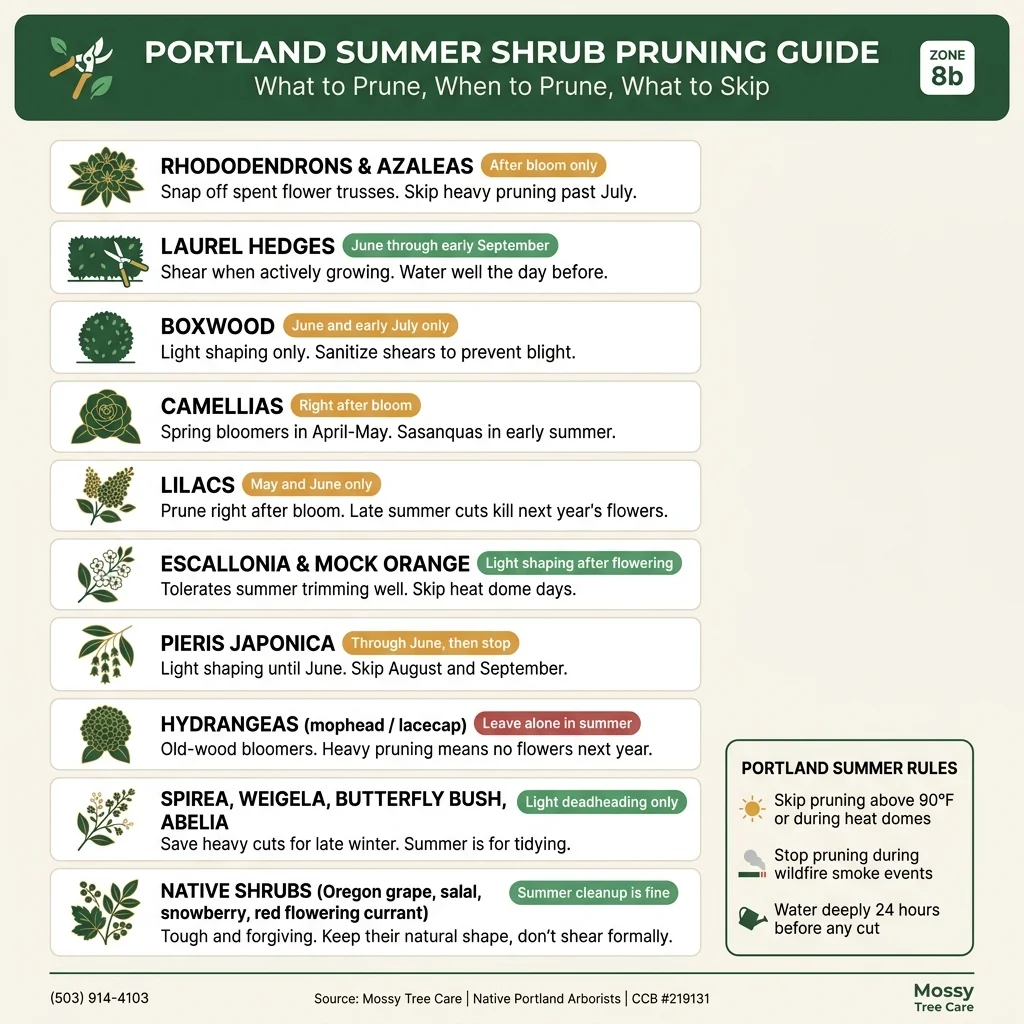
Rhododendrons and azaleas. Prune right after they finish blooming, usually late May through June. Snap off the dead flower trusses by hand to encourage next year’s buds. If the plant has gotten too big, you can take it down by about a third in early summer, but skip heavier pruning past July. These plants set next year’s flower buds in summer, and aggressive late-summer cuts mean a flowerless spring.
Laurel hedges. The workhorse of Portland fence lines. Laurel handles summer pruning beautifully and can be sheared anywhere from June through early September. The trick is to skip the hottest week of the month and water the hedge well the day before. Cherry laurel and Portuguese laurel both respond well to shaping when they’re actively growing.
Boxwood. Light shaping in June and early July is perfect for boxwood. Avoid pruning during heat waves because boxwood blight risk goes up with stressed, wet, freshly cut foliage. Sanitize your shears between plants. We see boxwood blight spreading through Portland neighborhoods every summer and the number one cause is dirty pruning tools.
Camellias. Prune right after the spring blooming variety finishes flowering, usually April or May. The fall-blooming sasanqua type gets pruned in early summer. Camellias don’t need much pruning at all, and over-pruning is more common than under-pruning.
Lilacs. Same as rhododendrons. Right after bloom in May or June. If you wait until July or August, you’re cutting off next spring’s flowers. We get this call every September from homeowners wondering why their lilac didn’t bloom. It’s almost always a late-summer trim from the year before.
Escallonia and mock orange. Both can be lightly shaped in summer after they finish flowering. Both also tolerate summer trimming better than national guides suggest, as long as you skip the heat dome days.
Pieris japonica (lily of the valley shrub). Prune lightly after spring bloom. Heavier shaping is fine through June. Skip August and September pruning.
Hydrangeas. This one depends on the type. Old-wood bloomers like mophead and lacecap hydrangeas should be left alone in summer. New-wood bloomers like panicle and smooth hydrangea (Annabelle) can be lightly tidied in summer if needed, but most pruning happens in late winter.
Spirea, weigela, butterfly bush, abelia. Light deadheading and shaping during summer is fine. The heavier cut happens in late winter or very early spring.
Native shrubs (Oregon grape, salal, snowberry, red flowering currant). Generally tougher than ornamentals and tolerate summer cleanup. Just don’t shear them into formal shapes, since they look their best with a natural form.
What You Should Not Prune in a Portland Summer
A short list of don’ts that will save you from costly mistakes.
Do not heavy-prune spring-flowering shrubs after early July. You’ll lose next year’s flowers because those buds are already set.
Do not shear hedges late in August or in September. Even though our winters are mild, late-season shearing pushes out tender new growth that gets damaged by the first cold snap and looks bad all winter.
Do not prune any shrub during a heat dome or extreme heat advisory. Pruning is a wound. Wounds heal slower when the plant is heat-stressed and water-stressed at the same time. Wait for a normal week.
Do not prune during wildfire smoke events when air quality is poor. Plants are already stressed by the particulate fallout on their leaves and reduced light. Adding pruning stress on top makes recovery harder.
Do not prune oaks at all from April through October. Different from shrubs, but worth mentioning because we get this question often. Oak wilt is a real risk in the Pacific Northwest now and summer pruning attracts the beetles that spread it.
The Three Weather Conditions That Change Everything
Portland summers used to be predictable. They’re not anymore. These three conditions should change your pruning plans the moment they show up.
Heat dome or 95-plus degree forecasts. Stop pruning. Wait until temperatures drop back into the 80s for at least three days. Pruning during extreme heat opens wounds when the plant has zero capacity to heal them, and you can lose entire branches or sometimes the whole shrub.
Drought stress visible in the leaves. If the leaves on your shrub look dull, droopy, or slightly curled at the edges before you’ve watered, that plant is stressed. Pruning a drought-stressed shrub is one of the worst things you can do. Water deeply for 24 to 48 hours first, see if the plant perks up, then make your cuts.
Wildfire smoke event. When Portland air quality dips into the red zone from Cascade fires, hold off. The plant is already coping with stress and reduced photosynthesis. Wait until air quality clears for several days.
How to Prune a Shrub in Summer Without Stressing It
A few small habits separate a healthy summer cut from a damaging one.
Water the shrub deeply the day before you plan to prune. Not a quick sprinkle. A real soak that gets water down to the root zone.
Prune in the early morning. Cool air, less direct sun on fresh cuts, and the plant has its full overnight water reserve. Avoid afternoon pruning between noon and 4 p.m. when temperatures peak.
Use clean, sharp tools. Dull shears tear the plant tissue instead of cutting it, which leaves a ragged wound that heals slowly and invites disease. Sharpen your bypass pruners once a season at minimum.
Sanitize between plants. Dip the blades in a solution of one part bleach to nine parts water, or wipe them with rubbing alcohol. Especially important if you’re moving between boxwoods, since blight spreads fast.
Don’t take more than 15 to 20 percent of the plant in a single summer session. Even shrubs that can handle hard pruning prefer to take it in winter when they’re dormant. In summer, light and frequent beats hard and rare.
Cut just above an outward-facing bud or branch junction. Avoid cutting into the middle of a stem with no bud nearby, which can cause dieback.
After you finish, water again. The plant just lost some of its leaf surface and is recovering.
When You Should Call an Arborist Instead
A few situations where DIY pruning ends and a professional should take over.
When the shrub is taller than you can reach safely from the ground. Ladder work near established hedges is one of the most common causes of homeowner injury in Oregon.
When the shrub is overgrown to the point of needing rejuvenation pruning, which is a 50 to 70 percent cut back to bare wood. That’s not a summer job, and it needs to be done with knowledge of how the specific species responds. A wrong move kills the shrub.
When the shrub is near power lines. Don’t prune anything within 10 feet of overhead electrical service yourself. Call PGE or a licensed arborist.
When you don’t know what species you have. Mystery shrubs get the worst summer pruning advice because generic rules don’t apply. An arborist can identify the plant in two seconds and tell you exactly when to prune it.
When the shrub has signs of disease or pest damage. Pruning before identifying the problem can spread it to the rest of the plant or to neighboring shrubs.
The Bottom Line for Portland Homeowners
Summer pruning isn’t the boogeyman that some national gardening sites make it out to be. For most common Portland shrubs, light shaping, deadheading, and removing dead wood in summer is good gardening, not bad timing. The real rules are simpler than you’d think. Skip the heat waves. Water before and after. Don’t take too much at once. Save the heavy stuff for late winter.
If you’re staring at a shrub in August wondering whether to grab the pruners, the question to ask isn’t “is it summer?” The question to ask is “is this plant healthy, hydrated, and is the weather reasonable this week?” If yes to all three, go ahead.