When a tree is cut down, most reputable tree removal companies reuse or recycle the wood rather than simply dumping it. In practice, crews will chip branches into mulch, sell or give away solid logs, split firewood, or send wood to recycling facilities. It’s rare for all that wood to go to waste – instead it often becomes mulch, lumber, or fuel. In the first paragraph we’ll answer the question directly, then break down the main uses in detail with examples and sources.
Here are the key ways tree services handle wood from a removed tree:
- Mulch and Compost: Small branches and debris are run through a chipper to create wood chips or mulch, which can go back on lawns and gardens as mulch or compost.
- Lumber and Pulp: Long, straight trunk sections (sawlogs) are often sold to sawmills or log processors for lumber, furniture, or wood products. Lower-grade wood may become pulp for paper or particleboard.
- Firewood and Biomass: Large logs may be cut and split for firewood (sold or given to homeowners), or chipped into biomass fuel. Many power plants and pellet manufacturers burn wood chips for energy.
- Donations and On-Site Uses: Sometimes crews leave usable wood for the homeowner or donate it. Utilities (like Portland General Electric) even give free wood chips to locals, and landscaping firms happily accept wood chips and logs as mulch.
- Disposal/Recycling: Anything that can’t be reused is taken to recycling or composting centers. In Oregon especially, regulations favor chipping or hauling away debris (rather than open-burning), and yard-waste facilities will turn clean wood into compost or biofuel.
Each option reduces waste and often benefits homeowners, gardeners, and the environment. Below we’ll explain each use in more depth, with examples and citations.
Wood Chips & Mulch
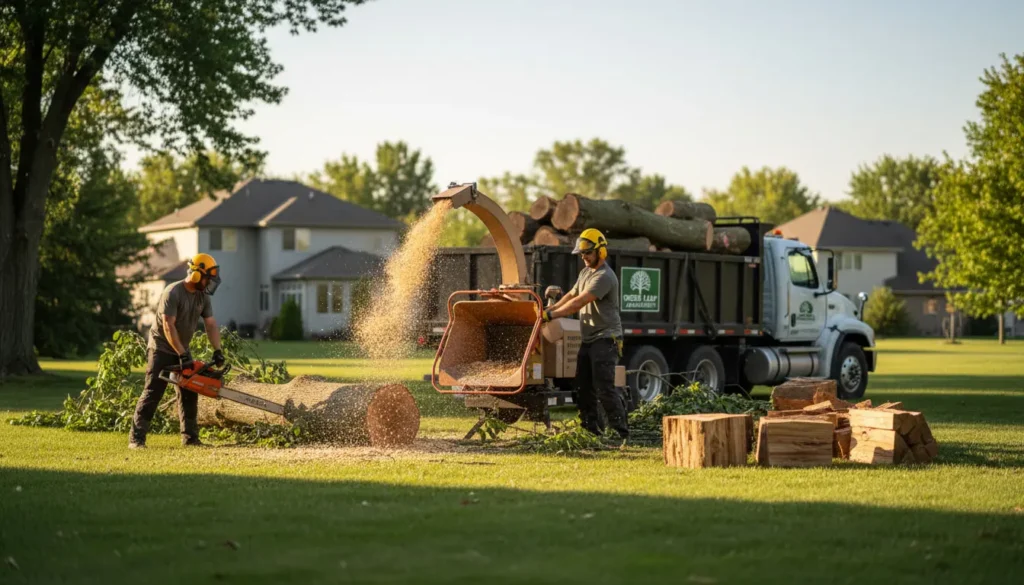
A common outcome is that all the branches and brush get chipped. Tree crews use a wood chipper to grind up limbs and brush on-site or at a yard. The resulting wood chips are excellent mulch: they hold moisture, suppress weeds, and slowly add nutrients to soil. For example, Oregon’s tree industry and utility companies encourage this reuse – Portland’s utility even offers free wood chips to residents for compost or garden use, In short, chipping turns messy tree waste into a useful product for soil and gardens.
- Local reuse: Homeowners often keep wood chips for mulch on their own property. Many tree services will even deliver or leave chips on site if asked. In some cities there are “chip drop” programs linking tree crews with residents who want free mulch.
- Commercial mulch: Excess wood chips often go to nurseries and garden centers. As Townsend Arborcare notes, “landscape suppliers and nurseries are always in need of wood chip mulch”. Some firms haul chips to municipal composting sites or sell bags of mulch.
By recycling branches this way, companies avoid burning and provide a valuable landscaping resource.
Lumber, Logs, and Wood Products
Straight, high-quality sections of trunk – especially from large or mature trees – can be worth money. Tree crews will grade and sort logs by size and species. The best logs (few knots, straight grain) are sold to sawmills. These “sawlogs” are cut into lumber for construction, flooring, furniture, or wood trim. For example, a professional forester explains that high-quality logs (sawtimber) are set aside for milling, while leftover wood is chipped. Santa Clarita Tree Service also notes that removal crews often truck logs to lumber mills or chip mills.
Even logs that aren’t perfect can be used. Many become pulpwood: they’re chipped or ground into fiber for paper, particle board, or oriented strand board. As Townsend Arborcare points out, “most wood, even that which is sold to log yards, ends up being pulpwood-grade” and is chipped into boards or paper products.
- Woodworking and furniture: On rare occasions, very fine logs (like special hardwoods) might go to custom woodworkers or furniture makers. More commonly, they end up as processed lumber.
- Pallets and boards: Some wood goes into industrial uses (pallets, crates, boards) if it’s too irregular for furniture.
- Local context: In Oregon and the Pacific Northwest, local mills may buy fire-tolerant or storm-felled logs. Logging contractors (like Sierra Valley Enterprises) emphasize maximizing timber recovery – selling sawlogs and chipping the rest for biomass.
In summary, large logs often get a second life as building material or paper. This is far preferable to sending them to a landfill – it keeps wood products local and useful.
Firewood & Energy
Thicker logs and large pieces often become firewood or energy fuel. If homeowners or tree crews split the wood, it can be stacked for fireplaces or wood stoves. Good firewood species (oak, maple, ash, etc.) are prized because they burn hot and clean. Many tree companies will cut and split logs to sell as firewood or may give some wood to the property owner. Even if not sold, split wood can be a homeowner’s free fuel for winter.
When wood is not used as cordwood, it may be chipped or processed into biomass fuel. Many power plants and biomass facilities burn wood chips for renewable energy. For example, Townsend Arborcare notes that utility-scale biomass energy plants are “turning to wood chips” for electricity. The U.S. Energy Information Administration confirms this trend: power plants in the United States burn wood (or co-fire wood chips with coal) to produce electricity.
- Wood pellets: Some logs go to pellet mills where they’re ground into sawdust, dried, and formed into pellets for pellet stoves (popular in colder regions).
- Biochar: In cutting-edge recycling, wood can even be turned into biochar – a charcoal-like soil enhancer – through slow-burning processes.
- Avoiding open burning: In Oregon especially, open burning of tree debris is heavily regulated. Companies prefer chipping or hauling wood away because burning often requires a permit.
Overall, using tree wood for heat and power is a win–win: it supplies energy and reduces carbon footprint compared to fossil fuels.
Other Uses, Donations, and Disposal
If wood isn’t used for mulch, lumber, or fuel, companies find other ways to handle it rather than simply tossing it. Some leftover logs and large pieces may be left on-site (if the customer wants them for firewood or decoration) or moved to another job. Crews sometimes form brush piles for wildlife habitat (in rural settings) or burn small piles in an “air curtain incinerator” as a last resort.
Tree services may also donate wood or chips. For instance, many companies advertise “free firewood” deals: they’ll remove a tree at low cost if they can keep the wood for fuel. Additionally, municipalities, non-profits, or neighbor communities might use cut wood for public projects (e.g. wood benches, plant staking, or fuel for community stoves). In Oregon, some utilities and civic programs explicitly give wood chips and occasionally wood logs to the public.
Finally, anything unusable goes to recycling or composting centers. Wood removal debris is treated much like yard waste: it can be taken to a yard debris recycling facility. For example, Oregon’s Allwood Recyclers accepts clean wood waste (branches, stumps, pallets, etc.) and turns it into compost or biomass fuel. Even Christmas trees are accepted as yard debris (Rogue Disposal in Medford charges a small fee to chip them). By law, municipalities prefer chipping and composting over open burning of such debris.
In all these ways chipping, selling, donating, and recycling tree removal companies aim to keep the wood in use. A stump grinder even turns the tree’s base into chips. The goal is to recover as much value as possible and minimize waste.
Conclusion:
When your tree is removed, don’t think its wood will just vanish. Chances are it will reappear as mulch in your garden, lumber in your home, or firewood in your stove. Tree services follow sustainable practices to reuse or recycle wood – selling logs, chipping brush, and working with local recyclers – so that very little actually goes to the landfill.